

 #All
#AllRed Light vs Blue Light Therapy
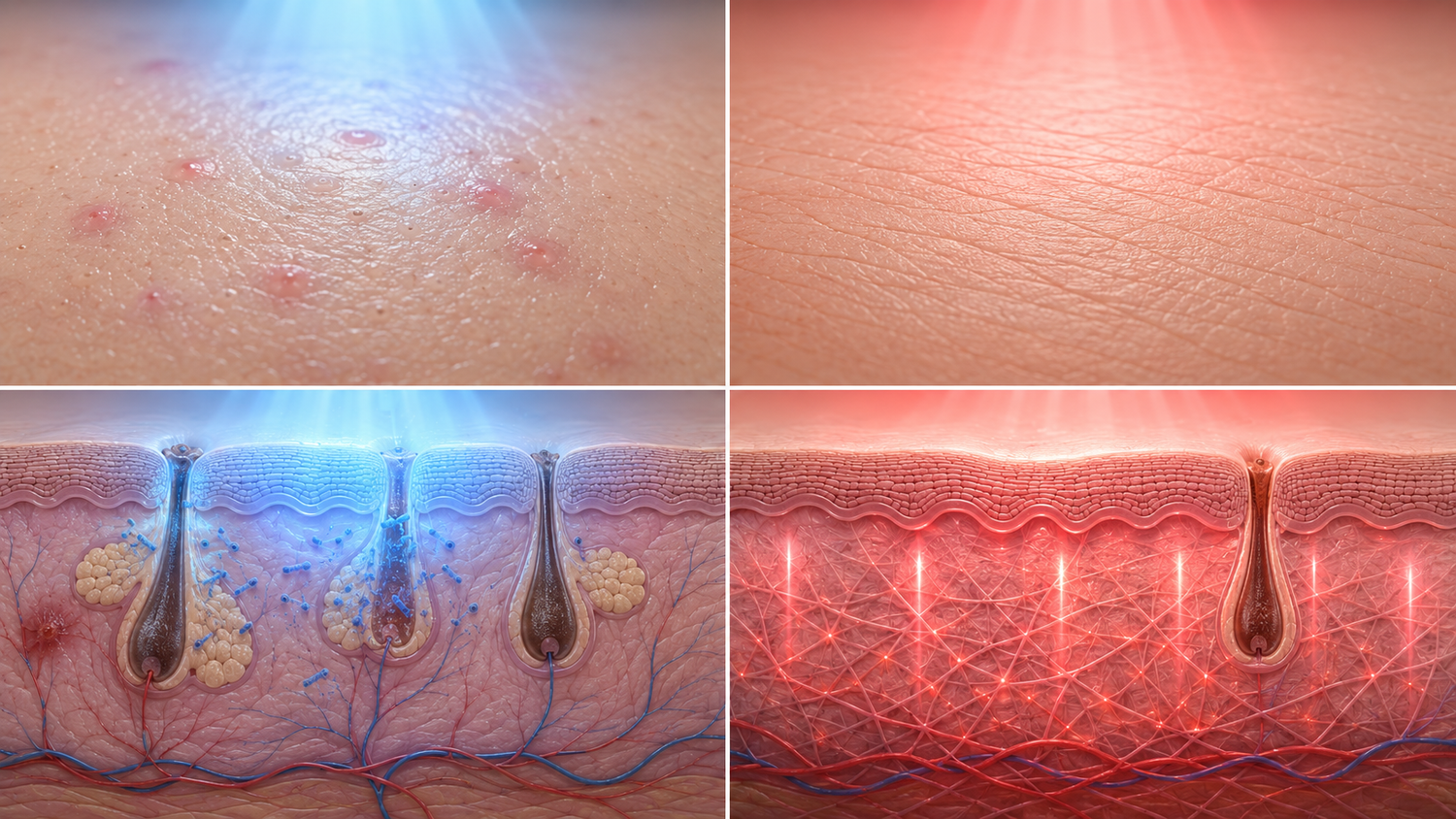
Red light therapy and blue light therapy solve different problems. Red light works deep in the skin to support collagen and elastin, targeting fine lines, texture, and firmness over time. Blue light works at the surface, where acne-causing bacteria live, and shows results considerably faster.
Choosing between them is less useful than understanding when each applies. Most skin has more than one concern, and the more capable LED masks run both wavelengths, which turns the question from which light to pick into how to use both properly.

Red Light Therapy
Red light therapy uses visible red wavelengths, typically around 630 to 660nm, alongside near-infrared light at roughly 850nm. Both are absorbed by the mitochondria inside skin cells, where a dermatology review of the mechanism describes activation of cytochrome c oxidase, modulating cellular energy production and triggering the signalling pathways behind how cells proliferate and behave. For skin, that supports the fibroblasts responsible for collagen and elastin.
Penetration depth is one of the main differences between red and blue light. Visible red light reaches deeper skin layers than blue, while near-infrared can penetrate deeper still. Neither penetrates far enough to be felt, and neither generates meaningful heat, which is why sessions are comfortable and require no recovery.
The results are gradual rather than immediate. Collagen synthesis is a slow biological process, and the visible outcomes, meaning softer fine lines, improved firmness and better overall texture, build over weeks of consistent use rather than appearing after a single session. Red light is a long-term commitment in the way that a good skincare habit is, and it rewards consistency more than intensity.

Blue Light Therapy
Blue light therapy uses shorter wavelengths, generally around 415 to 470nm, and works on an entirely different mechanism. Rather than stimulating cellular processes, it is understood to target Cutibacterium acnes, the bacteria involved in breakouts, which absorbs blue light and produces reactive oxygen species that damage the bacterial cell from within.
Shallow penetration is a feature rather than a limitation here. Acne-causing bacteria live in the pores and follicles near the skin surface, so a wavelength that stops at that depth reaches exactly what it needs to. Blue light also has a mild effect on sebum production, which is relevant for skin that runs oily.
Timelines are shorter than with red light. Breakout activity often responds within a few weeks of regular sessions, which makes blue light one of the few skincare interventions where the feedback loop is quick enough to be motivating. What it does not do is address lines, firmness, or texture, since none of those are bacterial problems.
What's the Difference Between Red and Blue Light Therapy?
The two differ in wavelength, in how deep they reach, in what they act on, and in how quickly they show results.
| Red Light | Blue Light | |
| Wavelength | Around 635nm, with near-infrared at 850nm | Around 415 to 470nm |
| Penetration | Reaches the dermis and deeper tissue | Stays at the skin surface and in pores |
| Acts on | Mitochondria in skin cells | Acne-causing bacteria in pores |
| Main use | Fine lines, firmness, texture, overall skin quality | Breakouts, congestion, oil control |
| Visible timeline | Weeks to months of consistent use | Often a few weeks |
| Best suited to | Aging concerns and long-term skin quality | Active breakouts and oily or congested skin |
Neither wavelength substitutes for the other. Using blue light on fine lines accomplishes nothing, because there is no bacterial target, and using red light alone on active breakouts leaves the underlying cause untouched. The mechanisms are unrelated, which is why the comparison matters less than knowing which concern is being treated.
Can You Use Red and Blue Light Therapy Together?
Yes, and for most skin it is the better approach. Because the two wavelengths act on unrelated targets, there is no interaction to avoid and no reason to treat them as alternatives.
Combining them is common enough that many devices offer a dedicated violet mode, which is simply red and blue running at the same time rather than a separate wavelength, addressing surface bacteria and deeper collagen support in one session. That combination suits skin dealing with breakouts and early aging concerns at once, which describes a large proportion of adult skin.
The more precise approach is treating different areas differently. Breakouts and oiliness rarely affect the whole face evenly, and neither do fine lines, so applying blue light where congestion sits and red light where texture and firmness matter reflects how skin actually behaves. Devices that allow zone-level control make that possible in one sitting rather than requiring separate sessions.

Green, Yellow Light Therapy and Other Colors
Red and blue are the two most studied wavelengths, and they are not the only ones LED devices offer.
Green light therapy sits at around 520 to 525nm and is used for pigmentation concerns, meaning dark spots, uneven tone, and the marks left behind after breakouts have cleared. It penetrates less deeply than red light and is often paired with it, since one addresses the discoloration while the other supports the skin quality underneath.
Yellow light, generally around 590nm, is associated with redness and sensitivity. It works close to the surface and is typically used on skin that reacts easily or looks flushed, where stronger interventions would be counterproductive.
Counting colors is where specifications get slippery. Violet, as covered above, is red and blue together rather than a wavelength of its own, so a device listing seven colors is often offering five or six distinct wavelengths plus the combinations between them.
Red and blue have the largest body of research behind them, which is why they anchor any serious device. The additional colors extend what a single mask can address, letting one device cover pigmentation and sensitivity alongside the aging and breakout concerns that red and blue handle.
How Often to Use Light Therapy
Treatment frequency depends on the device's wavelength, irradiance, and intended dose. Clinical protocols vary, so the manufacturer's recommended session duration and frequency should take priority over a universal schedule. Consistency matters, but longer or more frequent exposure is not automatically better.
Blue light follows a similar pattern during active breakouts, with regular sessions until congestion settles, then a reduced maintenance frequency once skin is clearer. Extending session length beyond the recommended range does not accelerate results for either wavelength, since the response plateaus once cells have absorbed what they can use.
A few practical points apply to both:
-
Clean, product-free skin allows light to reach it without interference
-
Consistency matters more than session length, so shorter and regular beats long and occasional
-
Eye protection should be built into any device used at close range
-
Results build gradually, and stopping means the maintenance effect stops too
-
Anyone taking medication that increases light sensitivity should consult a physician first
Which Light Therapy Is Right for Your Skin?
The answer follows from the concern rather than from the wavelength. Skin dealing primarily with fine lines, loss of firmness, or uneven texture needs red light and near-infrared. These are collagen and cellular energy concerns, and no surface treatment addresses them.
Skin dealing with active breakouts, congestion, or excess oil needs blue light, at least initially. Once breakouts settle, red light becomes relevant for the marks and texture changes left behind.
Skin dealing with both, which is most adult skin, benefits from access to both wavelengths rather than committing to one. This is where single-mode devices become limiting, since a mask offering only red light leaves breakouts untreated while a blue-only device does nothing for aging concerns.

Choosing an LED Light Therapy Mask
Wavelength range is the first thing to check. A mask offering only red light covers one half of the picture, and the more capable devices include red, near-infrared, and blue as a minimum, with the additional colors described above extending what a single device can address.
LED density and irradiance determine how much light actually reaches the skin. A higher count of properly calibrated LEDs delivers more even coverage than a sparse array, and irradiance, measured in mW/cm², indicates the intensity arriving at the surface.
Coverage and control decide how usable a device is in practice. Masks that treat the whole face at one wavelength apply the same treatment to areas with different needs, while zone-level control allows the light to match the skin underneath it.
The Artemis LED Mask & Neck System is built around that principle. It carries 1,080 LEDs across the face and neck plate, running red at 635nm, near-infrared at 850nm, blue at 470nm and a violet mode combining red and blue, alongside green, yellow and sky blue. Its app allows any of those wavelengths to be assigned to 16 separate facial zones, so red can run on the eye area while blue runs on the nose and cheeks in the same session.
Irradiance is rated at 45mW/cm², eye guards are built in, and the mask and neck plate can be used together or independently. The full Artemis range includes the mask alone, the neck plate separately, and a sterilizer case, with FedEx expedited shipping included.
Conclusion: Choosing Between Red and Blue Light Therapy
Red light and blue light are not competing options. Red works deep to support collagen and skin quality over months, blue works at the surface to reduce breakout activity within weeks, and the mechanisms behind them have nothing in common.
The practical consequence is that the right question concerns the skin rather than the light. Aging concerns call for red and near-infrared, active breakouts call for blue, and skin presenting both is served best by a device offering both rather than by choosing a side.
Whichever wavelength applies, consistency determines the outcome. Light therapy accumulates its effect over regular sessions, and a device used three times a week for months will do more than any single setting, intensity, or wavelength on its own.
Related Articles
#All #All
#AllLED Light Therapy for Under-Eye Bags
Read More #All
#AllRed Light vs Blue Light Therapy
Read More #All
#AllLED Face Mask Guide: Benefits and Routine Tips
Read More #All
#AllLED Light Therapy vs Microcurrent
Read More #All
#AllLED Light Therapy for Oily Skin
Read More #All
#AllBest Treatment for Sun-Damaged Skin
Read More #All
#AllHow to Repair a Damaged Skin Barrier
Read More #All
#AllHow to Fade Post-Acne Marks
Read More #All
#AllRed Light Therapy for Skin Texture
Read More #All
#AllMorning vs Night: When to Use an LED Mask
Read More #All
#AllLED Light Therapy for Neck and Décolleté
Read More #All
#AllLED Mask for Aging Skin
Read More#All
The 10 Best LED Masks Recommended by Dermatologists in 2026
Read More#All
The 10 Best LED Light Therapy Face Masks in 2026
Read More
/
Featured Products
Our most-loved products, hand-picked for you.


