

 #All
#AllRed Light Therapy Before and After: What Changes and When
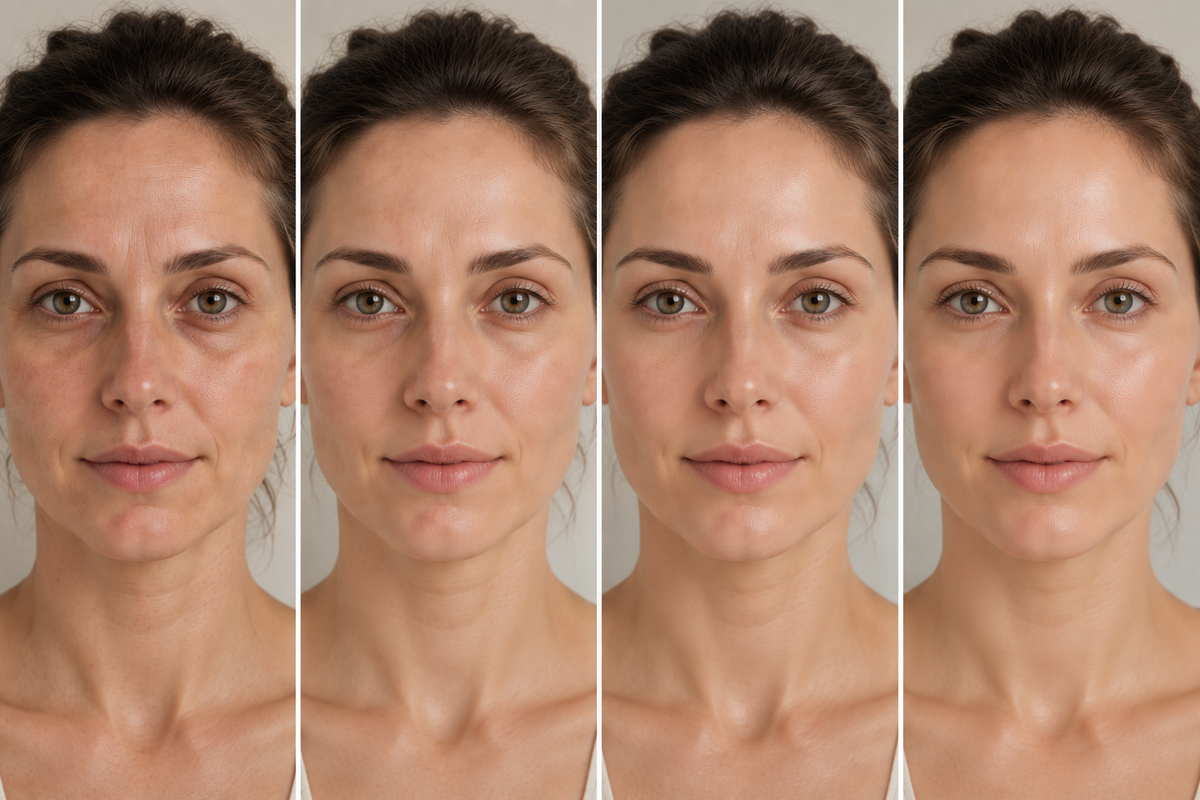
Before and after photographs are the least reliable way to judge red light therapy. Lighting, angle, expression and makeup account for more visible difference than most treatments do, and the honest version of a result here is gradual enough that a photograph taken a month apart may show very little.
What follows describes what actually changes and in what order, based on what the wavelengths do rather than on what a marketing image suggests. It also covers how to photograph your own progress in a way that means something, which is more useful than looking at anyone else's.
How Red Light Therapy Works on Skin
Red light at around 635nm and near-infrared at around 850nm are absorbed by mitochondria in the dermis, where they support the cellular energy production fibroblasts use to produce collagen and elastin. That single mechanism explains everything on the timeline below, since the changes people notice are downstream of collagen production increasing slightly each day and accumulating over months, which is why nothing dramatic happens quickly and why improvements continue as long as the routine does.
A randomized trial using these wavelengths recorded significant reductions in wrinkle depth and improvements in elasticity, alongside histological increases in collagen and elastic fibers. Those are measured outcomes rather than photographed ones, and they precede anything visible in a mirror by some margin.
The First Four Weeks
The earliest changes are tactile rather than visual, which is why so many people conclude nothing is happening and stop before anything does. Within the first two to four weeks, skin tends to feel smoother under the fingers and less tight after cleansing, and products that previously stung are often better tolerated. The texture change shows up first in thinner areas such as around the eyes, where skin that felt papery begins to feel softer.
Makeup behaves differently too, sitting more evenly and settling into lines less, which is frequently the first thing anyone notices without looking for it. None of that photographs well, since it is the kind of change you register while washing your face rather than while examining a mirror, and it arrives well before any difference in how skin looks. Hydration accounts for part of it, because anyone using a device consistently is usually also cleansing and moisturizing consistently, and the routine itself contributes alongside the light.
One to Three Months
This is where visible change begins, and where most people either commit to the routine or abandon it. Fine lines soften first, particularly the shallowest ones and those in thinner skin such as around the eyes, though the change is a reduction in depth rather than a disappearance, and it is usually noticed by comparison rather than directly. Skin tone becomes more even over the same period as circulation improves and cell turnover picks up, which shows most clearly in how skin reflects light, and photographs taken in consistent conditions start to show a difference at this stage where earlier ones would not have.
Texture continues improving from the early phase, with the surface becoming more uniform rather than simply smoother to the touch. Redness and reactivity often settle alongside it, though this varies considerably between people and is the least predictable of the changes on this list.
Six Months and Beyond
Longer-term use is where the structural changes accumulate enough to be obvious rather than subtle. Firmness is the clearest of them. Skin holding better along the jawline and across the cheeks reflects collagen density increasing over a sustained period, and it is the change people around you are most likely to comment on without knowing why. Deeper static lines soften alongside it without disappearing, since a line present at rest for years reflects long-term structural change and the realistic outcome is a reduction in depth rather than a removal.
Overall skin quality is the least specific improvement and often the most valued, with people describing skin looking healthier without being able to point at what changed. Results then plateau rather than stopping, as collagen production reaches a new equilibrium and the routine shifts from building to maintaining.

What Red Light Therapy Cannot Fix
Setting this out plainly prevents a routine from being judged against the wrong standard.
| Concern | Why it does not respond |
|---|---|
| Frown lines between the brows | Driven by muscle contraction rather than skin condition |
| Deep forehead creases on expression | The same muscle mechanism |
| Nasolabial folds | Volume loss beneath the skin, not a crease in it |
| Under-eye hollowing | Fat pad position and bone structure |
| Under-eye bags from displaced fat | Structural, beyond what any wavelength reaches |
| Existing scars | Tissue already remodeled |
Anyone whose primary concern is on that list will conclude red light therapy does nothing, and they will be right about that concern while missing what it did elsewhere. The distinction worth understanding is between lines caused by collagen loss and lines caused by muscle movement, since the first respond and the second do not, and a mirror with a relaxed expression separates them in seconds.
How to Track Red Light Therapy Results
Self-assessment fails over gradual change, because you see your face daily and adjust to it. A method removes that problem.
Photograph in Consistent Conditions
Same room, same time of day, same light source, and the same distance from the camera. Natural light from a window is the most repeatable, and overhead bathroom lighting is the least.
Keep the Variables Out
No makeup, the same neutral expression, the same angle, and the same hair position. Three photographs, straight on and both profiles, capture more than one does.
Space Them Properly
At the start, at six weeks, at three months, and at six months. Weekly photographs show nothing and encourage abandoning the routine.
Compare Like With Like
Look at the pairs side by side rather than at the most recent one alone, and compare the same lighting conditions rather than whichever photograph looks best.
Why Do Results Vary Between People?
Two people running identical routines can reach different points after six months, and the reasons are mostly identifiable:
- Device output. A mask publishing its irradiance in mW/cm² alongside its wavelengths can be assessed, while one listing only colors gives no way to judge whether its session length delivers a meaningful dose.
- Consistency. Light therapy accumulates, so four sessions a week over six months produces something a fortnight of daily use never will.
- Starting point. Skin with more residual collagen shows change sooner, and sun exposure history affects how much ground there is to make up.
- Fit. Light intensity falls with distance, so a mask sitting away from the skin delivers less to the areas it does not follow.
Choosing a Red Light Therapy Mask

Published specifications are the first filter, since the variables determining results are the ones most product pages omit.
Wavelength range decides what a device can address, with red paired with near-infrared covering the collagen concerns this article describes and additional colors extending the same device to breakouts, pigmentation, and redness. Coverage decides how evenly that arrives, since a mask treating the whole face with one wavelength applies the same treatment to areas needing different things, which is a limitation on any face with more than one concern.
The Artemis LED Mask publishes its full specification, carrying 720 LEDs across the face at 45mW/cm², running red at 635nm, near-infrared at 850nm, and blue at 470nm alongside green, yellow, and sky blue.
Its app assigns any wavelength to 16 separate facial zones, so red and near-infrared can run where firmness matters while other areas get what suits them, in a single session rather than several. The full Artemis range adds a neck plate for anyone extending the routine below the jawline.
Bottom Line: What Red Light Therapy Realistically Delivers
Red light therapy produces a gradual improvement in skin quality rather than a transformation, and the sequence is consistent: texture and comfort within a month, fine lines and tone between one and three months, firmness and deeper lines beyond six.
What it does not produce is the difference a before-and-after image usually implies, since those photographs are unreliable at the best of times and the genuine result here is subtle enough that lighting alone can hide or exaggerate it.
The way to know whether it is working is to photograph properly, wait three months before judging, and compare against the right concerns. Judged that way, the outcome is modest and real, which is more than most skincare delivers.
Related Articles
#All #All
#AllLED Light Therapy for Under-Eye Bags
Read More #All
#AllRed Light vs Blue Light Therapy
Read More #All
#AllLED Face Mask Guide: Benefits and Routine Tips
Read More #All
#AllLED Light Therapy vs Microcurrent
Read More #All
#AllLED Light Therapy for Oily Skin
Read More #All
#AllBest Treatment for Sun-Damaged Skin
Read More #All
#AllHow to Repair a Damaged Skin Barrier
Read More #All
#AllHow to Fade Post-Acne Marks
Read More #All
#AllRed Light Therapy for Skin Texture
Read More #All
#AllMorning vs Night: When to Use an LED Mask
Read More #All
#AllLED Light Therapy for Neck and Décolleté
Read More #All
#AllLED Mask for Aging Skin
Read More#All
The 10 Best LED Masks Recommended by Dermatologists in 2026
Read More#All
The 10 Best LED Light Therapy Face Masks in 2026
Read More
/
Featured Products
Our most-loved products, hand-picked for you.


