

 #All
What Does Green Light Therapy Do?
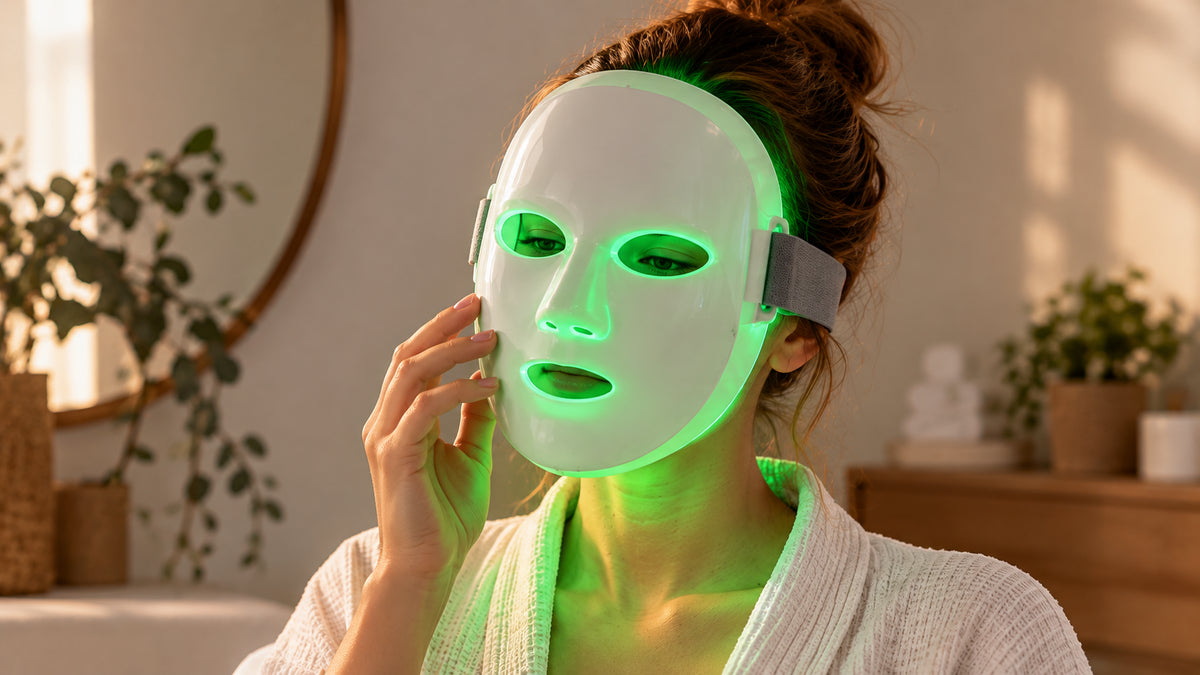
Green light therapy is the pigmentation setting on a multi-color LED mask. Where red works on collagen and blue works on breakouts, green at roughly 520 to 525nm is aimed at evenness: dark spots, patchy tone, and the discoloration left behind once a breakout clears.
That makes it the most frequently misunderstood of the common wavelengths, partly because it is sold on an outcome people want badly and partly because the research behind it is thinner than the marketing suggests. Both halves of that are worth setting out plainly, since green does something real and also does less than the claims around it imply.
What Is Green Light Therapy?
Green light therapy uses visible light in the 520 to 525nm range, delivered by LEDs rather than lasers in consumer devices. The wavelength sits between blue and yellow on the visible spectrum, which puts it in the shorter, shallower half of the range used in skincare.
Depth follows wavelength, and green reaches the upper layers of the skin rather than the dermis. It penetrates further than blue and considerably less than red or near-infrared, landing at the level of the basal epidermis where melanocytes, the cells that produce pigment, actually sit. That position is the entire argument for green: it stops where the pigment is made.
Devices usually offer it as one mode among several rather than as a standalone product, and that is a reasonable reflection of what it does. Green addresses one category of concern, which makes it a component of a multi-wavelength routine rather than a reason to buy a device on its own.
How Green Light Therapy Works on Skin
Photobiomodulation is the mechanism behind every wavelength in light therapy, including this one. Light absorbed by chromophores in the cell, chiefly cytochrome c oxidase in the mitochondria, raises cellular energy availability, and the cell then carries out its normal functions more actively.
Green works on that process in the pigment-producing cells specifically. Melanocytes respond to signals that tell them to produce more or less melanin, and the proposed action of green light is a calming one, moderating the activity of overactive melanocytes rather than removing pigment that already exists. Melanin itself absorbs green light efficiently, which is part of why this wavelength interacts with pigmented tissue more than with the structures below it.
Laboratory work gives that a specific pathway. A 2025 study in Acta Dermato-Venereologica found that green LEDs reduced melanin production in pigment-producing cells by suppressing the expression of MITF and tyrosinase, two of the controls on melanin synthesis, and lowered melanin content in a three-dimensional skin model without affecting cell viability. Suppressing synthesis is a different action from removing pigment, which is the distinction that governs everything else about how green behaves.
Two implications follow from that. Green does not bleach, strip, or exfoliate anything, so it cannot remove a spot already sitting in the skin, and it acts on production rather than on the visible result, which is why any change arrives gradually as existing pigment cycles out through normal cell turnover.
Green Light Therapy Benefits for Skin
Benefits cluster around tone rather than texture or structure, and each one works on the same mechanism at a different scale.
Dark Spots and Sun Spots
Localized patches of darker pigment are the headline use. Sun exposure over years prompts melanocytes to overproduce in specific areas, and green light is directed at that overproduction, so the realistic outcome is spots that become less distinct against the surrounding skin rather than spots that disappear.
Post-Breakout Marks
Flat brown or tan marks left behind after inflammation settles are the most responsive concern in practice, since they are relatively recent pigment rather than decades of accumulated damage. Green is often paired with red here, with green addressing the discoloration and red supporting the repair underneath it.
Overall Tone and Evenness
Diffuse unevenness, where no single spot stands out, but the whole face reads as patchy, is the subtler application. Change is harder to perceive than with a discrete spot and usually shows up as skin that looks more uniform in photographs rather than as a difference anyone could point to.

Does Green Light Therapy Fade Dark Spots?
Green light moderates pigment production rather than clearing pigment already in the skin, so fading happens indirectly and slowly. Existing discoloration leaves through normal epidermal turnover, which runs on a cycle of weeks, and the realistic horizon for visible change is three to six months of consistent sessions rather than a few weeks.
Expectations are where this goes wrong. A spot that has been there for a decade reflects long-term melanocyte behavior and accumulated damage, and light therapy at consumer intensities is not equivalent to in-clinic pigment treatments, which use far higher energies and target pigment directly. Anyone with pigmentation as their primary concern is better served treating green light as support alongside a topical routine and daily sun protection.
Sun protection in particular is not optional here. Ultraviolet exposure is the main driver of melanocyte overactivity, and running green light sessions while continuing to accumulate UV exposure means treating a cause that is being actively reinforced. Daily SPF does more for pigmentation than any light therapy mode, and the two work in the same direction rather than competing.

Green Light Therapy for Dark Circles
Under-eye darkness comes in several forms, and green light is relevant to only one of them. Pigmented circles, where the skin under the eye is genuinely darker than the surrounding area, involve the same melanocyte activity green is aimed at, which puts them within reach.
Vascular and structural circles are different problems entirely. Darkness caused by blood vessels showing through thin skin is a circulation and translucency issue, which red and near-infrared address more sensibly through dermal support, and shadowing caused by hollowing or a deep tear trough is a volume issue that no wavelength of light can fill. Mixed presentations are common, which is why a single mode rarely resolves the whole appearance.
Caution around the eyes matters more than the wavelength. Eye protection should be used as the manufacturer specifies, and the thin skin in that area is best treated with the device's standard settings rather than extended exposure.
Green vs Red and Blue Light Therapy
Comparing the three common wavelengths makes the division of labor clear, since each stops at a different depth and acts on different cells.
| Green 520-525nm | Blue 415-470nm | Red 630-660nm | |
|---|---|---|---|
| Depth reached | Basal epidermis | Epidermis and follicle | Dermis |
| Target cells | Melanocytes | Acne-causing bacteria | Fibroblasts |
| Primary use | Pigment and uneven tone | Active breakouts | Collagen, texture, fine lines |
| Evidence base | Limited, small studies | Strongest of the three | Extensive |
| Typical timeline | 3 to 6 months | 8 to 12 weeks | 2 to 6 months |
| Works best | Alongside red | On congested areas only | Paired with near-infrared |
Red and blue carry the volume of published work, and green sits well behind both. The practical reading is that green belongs on a device that also runs red and near-infrared rather than being chosen in preference to them, and that a mask offering green alone would be covering the narrowest concern with the weakest support.
How to Use Green Light Therapy on the Face
Clean, dry skin comes first, with no serum or moisturizer between the light and the face, since products sitting on the surface change how much light arrives and most have never been tested under LED exposure. Skincare goes on afterward.
Session length and frequency belong to the device rather than to general advice. Delivered dose is irradiance multiplied by time, and because every mask runs a different output, the manufacturer's stated duration and weekly schedule are the figures to follow rather than a number borrowed from another device or from an article. Anyone unsure how green light fits alongside prescription pigment treatments should raise it with a dermatologist first.
Pairing beats isolation. Green on its own addresses discoloration while doing nothing for the texture and firmness underneath it, so most routines run red and near-infrared across the face as the baseline and bring green in for the areas where tone is the issue, which is also why a device that lets different wavelengths run in different places is more useful than one that treats the whole face identically.

Green Light Therapy LED Mask
Pigmentation rarely covers a whole face evenly, which is what makes zone control relevant to this wavelength in particular. The Artemis LED Mask publishes green at 525nm as one of seven named wavelengths, alongside red at 635nm, near-infrared at 850nm, blue at 470nm, amber at 590nm, sky blue at 520nm and violet, with output stated at 720 LEDs delivering 45mW/cm².
The app divides the face into 16 zones that take their own wavelength, so green can sit on the cheekbones or forehead where sun spots are, while red and near-infrared cover everything else in one session. Those assignments persist from one session to the next, which suits a concern measured in months, and eye guards are built into the mask rather than supplied loose. Coverage extends below the jawline with an optional neck plate, listed across the wider Artemis lineup.
The Takeaway: What Green Light Therapy Is Good For
Green light therapy at 520 to 525nm reaches the layer where pigment is produced and works by moderating melanocyte activity rather than removing existing discoloration. Post-breakout marks respond most readily, sun spots and general unevenness more slowly, and the timeline runs to months because existing pigment has to cycle out through normal turnover.
The honest limits are worth holding onto. Evidence for green is thin next to red and blue, consumer devices are not equivalent to in-clinic pigment treatments, and nothing green light does survives continued UV exposure without daily sun protection alongside it.
Where it earns its place is as part of a multi-wavelength routine, running on the areas that need it while red and near-infrared do the structural work everywhere else.
Related Articles
#All #All
Common LED Mask Mistakes
Read More #All
LED Light Therapy for Combination Skin
Read More #All
Red Light Therapy Before and After: What Changes and When
Read More #All
LED Light Therapy for Under-Eye Bags
Read More #All
Red Light vs Blue Light Therapy
Read More #All
LED Face Mask Guide: Benefits and Routine Tips
Read More #All
Starting LED Light Therapy in Your 20s
Read More #All
LED Light Therapy vs Microcurrent
Read More #All
LED Light Therapy for Oily Skin
Read More #All
Best Treatment for Sun-Damaged Skin
Read More #All
How to Repair a Damaged Skin Barrier
Read More #All
How to Fade Post-Acne Marks
Read More #All
Red Light Therapy for Skin Texture
Read More #All
Morning vs Night: When to Use an LED Mask
Read More #All
LED Light Therapy for Neck and Décolleté
Read More #All
LED Mask for Aging Skin
Read More#All
The 8 Best Luxury LED Face Masks in 2026
Read More
/
Featured Products
Our most-loved products, hand-picked for you.


