

 #All
LED Light Therapy for Combination Skin
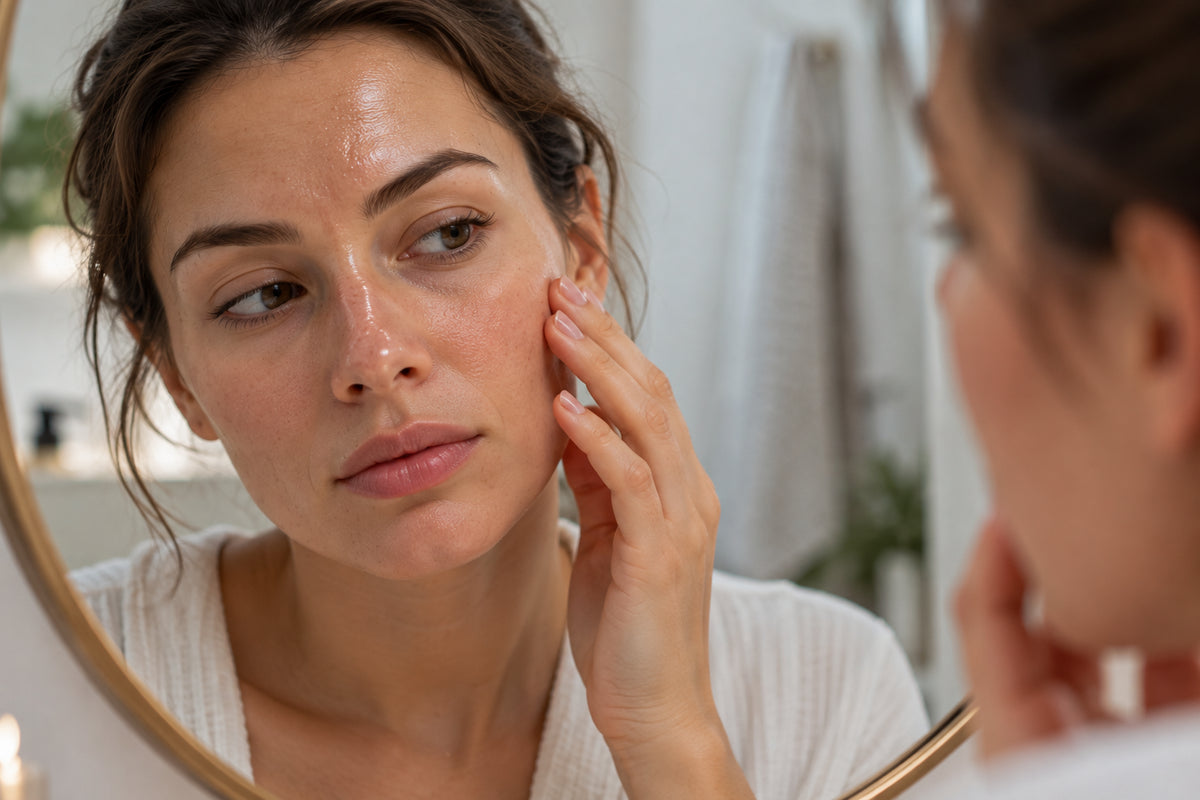
Combination skin is the hardest skin type to treat with a single product, because any routine strong enough to control the T-zone tends to leave the cheeks tight and flaking. Most people end up compromising in one direction and living with the consequences in the other.
LED light therapy sidesteps part of that problem, since light does not strip or occlude anything. Different wavelengths suit different zones, and the useful question is less whether LED helps combination skin than how the wavelengths get distributed across a face that needs two different things at once.
What Is Combination Skin?
Combination skin produces excess oil in some areas and too little in others, usually with an oily forehead, nose, and chin alongside normal to dry cheeks and jawline. The pattern follows the distribution of sebaceous glands, which sit far more densely through the central face than around the outer edges.
Sebum output in those central glands is driven largely by androgens, and the gland density means the same hormonal signal produces visibly different results an inch apart. That is why the T-zone shines by midday while the cheeks feel tight after cleansing, and why the two areas can present completely different concerns at the same time: congestion and visible pores through the center, dullness and fine texture across the sides.
The balance also shifts. Humidity, season, hormonal cycles, and the products in use all move the line between the oily and dry zones, which is one reason a routine that worked in July stops working in January.
Why Combination Skin Is Hard to Treat
Treating combination skin means applying two opposing strategies to one surface. Oil control relies on actives that reduce sebum and clear follicles, while dryness needs barrier support and lipid replacement, and the two sets of ingredients work against each other wherever they overlap.
Most routines resolve the tension by picking a side. Treating the whole face for oil leaves the cheeks compromised, with tightness, flaking, and the sensitivity that follows a weakened barrier. Treating the whole face for dryness leaves the T-zone congested and the pores more visible. Multi-masking and zone-specific application exist precisely because of this, though they depend on precision most people do not maintain daily.
Dehydration complicates the picture further. An oily T-zone can be dehydrated at the same time, producing the common situation where skin feels tight and looks shiny in the same spot, and the usual response of adding more oil control makes it worse. That distinction matters for what comes next, because light therapy treats oil and dehydration through entirely different wavelengths.
Does LED Light Therapy Work for Combination Skin?
LED light therapy suits combination skin better than most topical approaches, for a structural reason rather than a clinical one: light adds nothing to the skin surface. Nothing is stripped, nothing occludes the follicles, and the barrier is not challenged by an active ingredient, so the usual trade-off between the two zones largely disappears.
The mechanism is photobiomodulation. Light at specific wavelengths is absorbed by cytochrome c oxidase in the mitochondria, cellular energy production rises, and the cells involved carry out their normal work more actively. For the oily zone, blue light at 415 to 470nm reaches the follicles where acne-causing bacteria sit. For the dry zone, red light at 630 to 660nm reaches the dermis where fibroblasts produce collagen and elastin.
What LED does not do is change how much oil the skin produces. Sebum output is hormonally driven, and no light therapy device alters that. Blue light addresses the bacterial component of congestion rather than the oil feeding it, which means a T-zone treated with blue light produces the same amount of sebum and breaks out less. Managing shine itself remains a job for cleansing, texture-appropriate moisturizers and, where relevant, topical actives.
Best LED Wavelengths for Combination Skin

Combination skin draws on more of the wavelength range than any single skin type, because it presents concerns from both ends of it. The table below sets out which wavelength suits which zone and what it addresses there.
| Wavelength | Depth reached | Zone it suits | What it addresses |
|---|---|---|---|
| Blue 415-470nm | Epidermis and follicles | T-zone | Acne-causing bacteria, active congestion |
| Cyan 490-520nm | Upper epidermis | T-zone and jawline | Surface calming, post-breakout irritation |
| Green 525nm | Basal layer, melanocytes | Both, cheeks in particular | Melanin activity, post-breakout marks, uneven tone |
| Yellow 590nm | Superficial vasculature | Cheeks | Redness, diffuse flushing, sensitivity |
| Red 630-660nm | Dermis, fibroblasts | Both, cheeks in particular | Collagen support, texture, fine lines, barrier recovery |
| Near-infrared 830-850nm | Lower dermis and below | Both | Deeper structural support, recovery |
Two things follow from that distribution. Red and near-infrared are the only wavelengths that genuinely suit the entire face, which makes them the baseline for combination skin rather than an aging-specific choice. Blue is the opposite case, since it is the one wavelength with a clear reason not to run everywhere: the dry cheeks gain nothing from it, and blue light has been associated with oxidative stress and pigment activity on skin that does not need it.
LED Light Therapy for the T-Zone
The T-zone needs blue light for congestion and red light for everything else, which is a narrower requirement than it first appears. Blue at 415 to 470nm targets the bacteria involved in inflammatory acne, and the research behind it is the strongest in the whole field of consumer LED therapy, with multiple controlled trials showing reduced inflammatory lesion counts over eight to twelve weeks.
Red light belongs in the same zone for a different purpose. Enlarged pores through the nose and cheeks reflect collagen loss around the follicle wall as much as oil volume, since a follicle with less structural support around it holds its shape less well and reads as a larger pore. Red light acts on that structural component, which is why a T-zone protocol built on blue alone addresses breakouts while leaving visible pores unchanged.
Cyan and green have supporting roles here, with cyan used for surface calming after active breakouts settle and green for the marks they leave behind. Both carry thinner evidence than blue and red, and both are better treated as useful additions than as reasons to buy a device.

LED Light Therapy for Dry Cheeks
Dry cheeks need the opposite end of the spectrum, and red light at 630 to 660nm does most of the work. Fibroblast activity in the dermis supports collagen and elastin synthesis, and skin with better structural support underneath holds moisture more effectively and recovers faster from the irritation that dryness invites. Near-infrared at 830 to 850nm extends the same support deeper, which is why the published work on firmness and elasticity is mostly built on the two wavelengths in combination rather than red alone.
Yellow at 590nm handles the redness that often accompanies a compromised barrier on this part of the face. The wavelength is absorbed in the superficial vasculature where diffuse flushing originates, and it suits reactive skin because it generates no heat and produces no stinging response.
Barrier repair itself is worth separating from light therapy, since LED supports the cells that rebuild the barrier without replacing the lipids it is made of. Ceramides, cholesterol, and fatty acids come from the routine rather than the device, and the cheeks of a combination-skin face usually need them regardless of how consistent the sessions are.
LED Routine for Combination Skin
Running two protocols on one face takes some ordering. The approach below assumes a device that treats zones separately; where that is not possible, the alternative is to alternate modes across sessions rather than within them, which works but roughly halves the weekly exposure each zone receives.
Session Order
Clean, dry skin comes first, with no product in between, since serums and moisturizers sit between the light and the skin and most have not been tested for how they behave under it. Red and near-infrared run across the whole face as the baseline, then blue is applied to the T-zone only, and skincare goes on afterward while circulation is still elevated.
Weekly Frequency
Many LED protocols use several sessions per week, but the manufacturer's recommended schedule should take priority. More frequency does not produce faster results, because photobiomodulation follows a biphasic dose response where benefit rises to an optimum and then declines, and the cells involved need recovery time between exposures.
What to Adjust After a Month
Four weeks is enough to judge comfort and tolerance rather than results. Cheeks still tight suggest the issue is the routine around the sessions rather than the sessions themselves, while a T-zone showing no change in congestion usually means the blue exposure is too short or too infrequent. Anything that stings, flushes, or feels warm during a session should be reduced in duration before it is abandoned.
LED Results Timeline for Combination Skin
Combination skin improves on two separate clocks, which is the detail most people are not told. Congestion in the T-zone responds fastest, with reduced inflammation often visible within two to four weeks and the clinical trials on blue light generally reporting meaningful lesion reduction across eight to twelve weeks.
The dry zone takes considerably longer, since collagen synthesis is slow and no device accelerates it. Texture and comfort shift within the first month, fine lines and tone between one and three months, and firmness beyond six. That gap between the two zones is worth expecting rather than reading as failure, because a face where the T-zone has cleared, and the cheeks look much the same at week six is behaving exactly as it should.
Both sets of changes depend on continuing. Light therapy supports an ongoing cellular process rather than producing a permanent result, and the improvements fade gradually over months once sessions stop.

Choosing LED Mask for Combination Skin
Combination skin is the clearest case for treating the face in sections rather than as one surface, and that is what the Artemis LED Mask is built around. Its app assigns any of its wavelengths to 16 independently selectable facial zones, so blue can run on the nose, forehead, and chin while red and near-infrared run on the cheeks, in a single session rather than across several.
- Seven wavelengths – red at 635nm, near-infrared at 850nm, blue at 470nm, green at 525nm, amber at 590nm, sky blue at 520nm and violet, covering both ends of the range combination skin draws on.
- 720 LEDs at 45mW/cm² – enough delivered dose for short sessions, with the irradiance figure published rather than described.
- 16 independent zones – the T-zone and cheeks treated differently at the same time, which is what removes the compromise.
- Built-in eye guards – protection during sessions without a separate accessory.
- Optional neck plate – extends red and near-infrared below the jawline, where dryness usually continues.
Zone assignment is saved between sessions, so a protocol worked out over the first month runs the same way every time without being rebuilt. The full Artemis range covers the neck plate and the rest of the line.
Bottom Line: Balancing Combination Skin
Combination skin is best treated as two problems on one face rather than one problem with a compromise attached. Blue light for the congested T-zone and red with near-infrared for the dry cheeks address each zone on its own terms, and because light adds nothing to the surface, neither protocol undermines the other the way opposing topical actives do.
Light therapy will not change how oily the T-zone is or replace the lipids the cheeks are missing, both of which stay with the routine around the sessions. Expect the two zones to improve on separate timelines, with congestion shifting inside the first month and the cheeks taking three to six, and treat the gap between them as normal rather than as a failing protocol. Give it twelve weeks before judging, and keep the blue light on the areas that actually need it.
Related Articles
#All #All
Common LED Mask Mistakes
Read More #All
LED Light Therapy for Combination Skin
Read More #All
Red Light Therapy Before and After: What Changes and When
Read More #All
LED Light Therapy for Under-Eye Bags
Read More #All
Red Light vs Blue Light Therapy
Read More #All
LED Face Mask Guide: Benefits and Routine Tips
Read More #All
Starting LED Light Therapy in Your 20s
Read More #All
LED Light Therapy vs Microcurrent
Read More #All
LED Light Therapy for Oily Skin
Read More #All
Best Treatment for Sun-Damaged Skin
Read More #All
How to Repair a Damaged Skin Barrier
Read More #All
How to Fade Post-Acne Marks
Read More #All
Red Light Therapy for Skin Texture
Read More #All
Morning vs Night: When to Use an LED Mask
Read More #All
LED Light Therapy for Neck and Décolleté
Read More #All
LED Mask for Aging Skin
Read More#All
The 8 Best Luxury LED Face Masks in 2026
Read More
/
Featured Products
Our most-loved products, hand-picked for you.


