

 #All
#AllMorning vs Night: When to Use an LED Mask
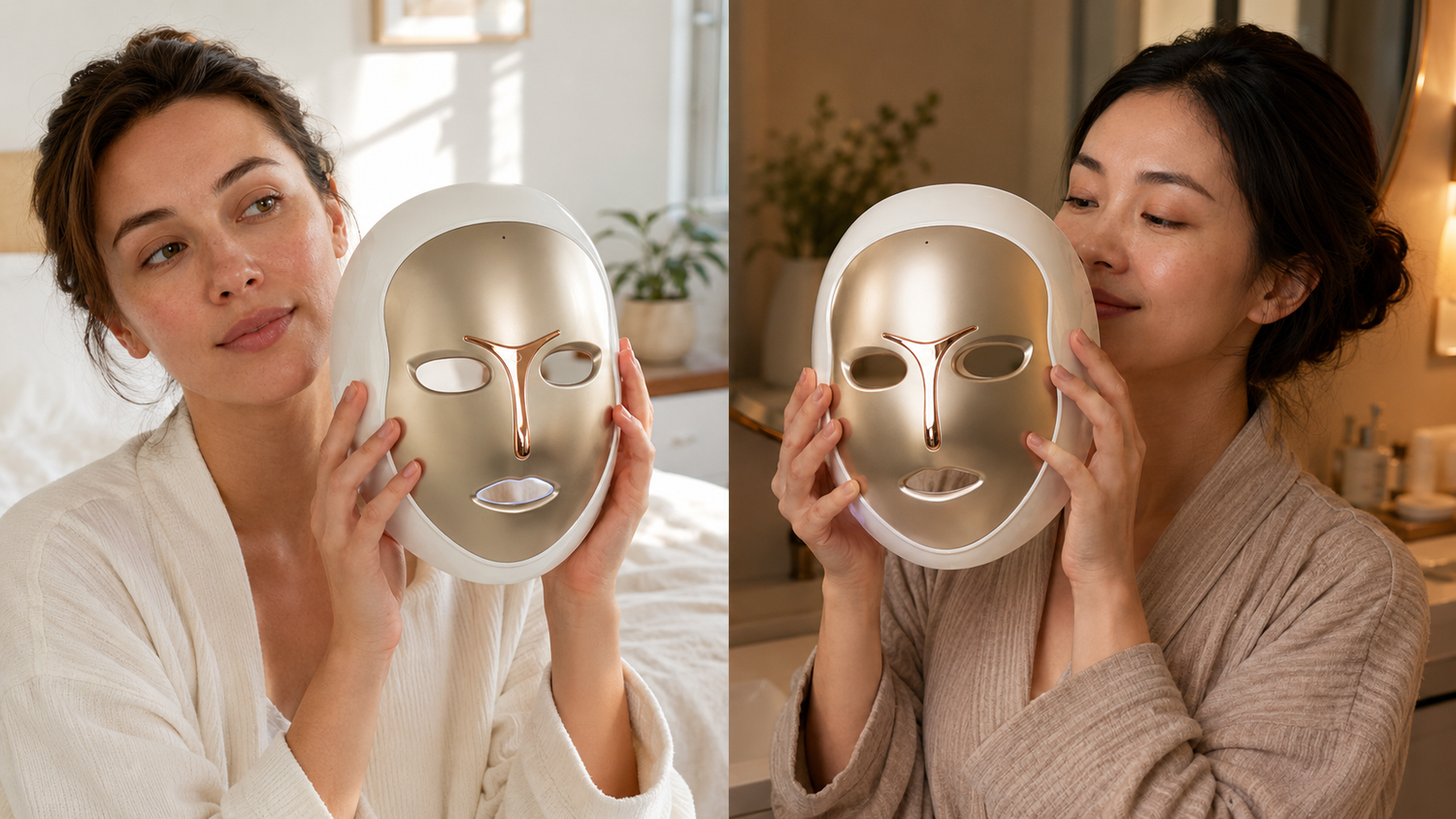
There is no wrong time of day to use an LED mask. Timing is a scheduling decision rather than a clinical one, and no evidence suggests the skin responds differently to light depending on the hour.
What does change with timing is everything around the session. Morning use has to work around makeup and sunscreen, evening use fits naturally after cleansing, and the schedule that gets followed consistently will produce better results than the one that is theoretically optimal and skipped twice a week.
When Is the Best Time to Use an LED Mask?
The best time is whenever the session actually happens. Light therapy works through accumulated exposure, so the effects build across sessions rather than depending on any single one landing at the right hour, and a routine that survives a busy week will always outperform a theoretically optimal one that gets skipped.
Timing does shape everything around the session, though, from how easily it fits into an existing routine to which wavelengths make sense at that hour. Those practical differences are what separate a morning schedule from an evening one.

Using an LED Mask in the Morning
Morning sessions suit anyone who wants the day's routine finished before the day starts. Evenings tend to be the least predictable part of a schedule, and a mask used at seven in the morning gets used more reliably than one that depends on energy still being available at eleven at night.
The constraint is competing with everything else happening at that hour. Hands-free devices matter more in the morning than at any other time, since a mask that stays in place allows the session to run while getting dressed or making coffee rather than requiring the day to stop for it.
One wavelength consideration is worth mentioning, with the caveat that the research concerns prolonged screen exposure rather than short masked sessions with eye protection in place. Blue light in the evening has been linked to effects on melatonin, so anyone who notices a difference in how they sleep can simply run red and near-infrared at night and leave blue for the morning.

Using an LED Mask at Night
Evening sessions have the advantage of slotting into a routine that already exists. Makeup and sunscreen come off, skin gets cleansed, and the mask goes on at exactly the point in the sequence where light therapy belongs, with no extra steps added to the day.
Time pressure is also lower, so the session runs to its proper length rather than being cut short. For many people it becomes a genuine pause at the end of the day rather than another task, which is worth something in itself when the main obstacle to any routine is whether it feels like a chore.
One wavelength consideration applies specifically here. Blue light in the hours before sleep is associated with disrupted melatonin production, and while a masked session with built-in eye protection is a different proposition from screen exposure, anyone sensitive to that would reasonably run red and near-infrared at night and leave blue for the morning.
Can You Use an LED Mask Twice a Day?
Whether a device supports twice-daily use is a question for its manufacturer rather than a general rule, since recommended frequency varies considerably between masks. What is documented is that more exposure does not mean more benefit. Research on photobiomodulation has found that the response reaches a maximum at a certain dose, after which it diminishes rather than continuing to improve, so doubling sessions inside a day is not a route to faster results.
Splitting wavelengths across the day is the version that makes most sense, where twice-daily use is permitted. Blue in the morning, where congestion sits, and red with near-infrared at night address two separate concerns, which is a better reason to run two sessions than to hope a repeated treatment works faster.
The stronger argument for a single daily session is that it is easier to sustain. Two sessions a day is a commitment most routines abandon within a month, while one is a habit that holds, and light therapy rewards the routine that lasts rather than the one that starts intensively.
Anyone considering twice-daily use should check the manufacturer's guidance for their specific device, since recommended session frequency varies with intensity and wavelength output.
How LED Fits Into a Skincare Routine
Light therapy works on bare skin, which means everything else in a routine happens afterward, and what goes on next is worth some thought. Skin is receptive immediately after a session, so this is the point where actives and hydrators do their best work rather than a moment to rush through.
Hydrators and Barrier Support
Hyaluronic acid, glycerin, ceramides, and panthenol are the most reliable pairing with any wavelength. They replace moisture without introducing actives that need their own timing, which makes them the straightforward option for post-session skin.
Peptides and Niacinamide
Both are widely used in routines built around skin quality and firmness, which makes them a natural fit alongside red light rather than a competing choice. Neither needs to be applied at any particular point relative to a session beyond going on afterward rather than before.
Vitamin C and Retinol
These belong after a session rather than before, and never underneath the mask. Both are actives that light can degrade, or that can increase sensitivity, and applying them to clean skin afterward gives each a clear run without interference.
Exfoliating Acids
AHAs and BHAs need more separation than the rest. They leave skin temporarily more reactive, so using them on a different evening from an LED session is more comfortable than stacking the two, particularly for anyone whose skin flushes easily.
Sunscreen
Non-negotiable in the morning, regardless of what else the routine includes. Light therapy does not increase sun sensitivity the way some treatments do, though a routine built around skin quality is undermined by skipping the single most effective protective step.
Anyone using prescription topicals, photosensitizing medication, or treating a diagnosed skin condition should confirm with a physician before combining them with light therapy.
How Often to Use an LED Mask
Frequency and session length are both set by the device rather than by any universal rule, and manufacturers differ on both. Around three sessions a week is a common starting recommendation, with some devices supporting daily use, though the instructions supplied with a specific mask are what should govern the routine.
What holds across devices is that longer sessions are not a shortcut. Exceeding the recommended duration is not how results arrive, and manufacturers set those limits for reasons specific to their own output and intensity.
Building up gradually is the sensible approach with any new device. Starting at the lower end of the recommended frequency gives skin time to adjust and makes it easier to notice how it responds, which matters more for anyone with reactive skin or anyone combining light therapy with active ingredients already in their routine.
What makes the biggest difference over time is simply keeping the routine going. Light therapy is a long game, and a schedule that fits comfortably into a normal week will do more than an ambitious one abandoned after a fortnight.
How Long Before You See Results From an LED Mask?
Timelines differ by wavelength and by concern, and none of them are immediate. Blue light shows the fastest feedback, with breakout activity often responding within a few weeks of regular sessions. That speed makes it the easiest wavelength to stay motivated with, since the results are visible before enthusiasm runs out.
Red light and near-infrared work on a longer horizon. Collagen synthesis is a slow biological process, and improvements in firmness, fine lines and texture build across weeks and months rather than days. Most people notice a change in how skin looks and feels before any measurable change in lines.
Neither timeline is affected by whether sessions happen in the morning or at night. What does affect it is how many sessions accumulate, which brings the question back to whichever slot in the day is realistic to keep.

Choosing an LED Mask That Fits Your Routine
Session length, comfort, and wavelength range all determine whether a device gets used often enough to matter. Wavelength coverage decides how much a single mask can address, since one offering red, near-infrared, and blue covers aging concerns and breakouts between them, while additional colors extend that to pigmentation and sensitivity.
Fit is what decides whether a session is pleasant or endured. A mask that holds its position hands-free allows the session to overlap with something else, which is what makes a morning slot workable and a daily habit realistic rather than aspirational.
The Artemis LED Mask carries 720 LEDs across the face, running red at 635nm, near-infrared at 850nm and blue at 470nm alongside green, yellow and a violet mode. Its app assigns any of those wavelengths to 16 separate facial zones, so a morning session can run blue where congestion sits while an evening session runs red and near-infrared across the whole face.
Sessions begin at a 10-minute factory setting and extend to 30 minutes, with built-in eye guards and a silicone construction that stays in place through a full session. The wider Artemis range adds a neck plate and a sterilizer case for anyone extending the routine beyond the face.
Verdict: Best Time to Use an LED Mask
Morning and evening sessions deliver the same light to the same cells, and no evidence suggests that timing changes what light therapy does. Evening suits most routines better simply because skin is already clean and time is easier to find, while morning works for anyone whose evenings tend to disappear.
What matters far more is the sequence and the frequency. Light needs clean skin to reach, products go on afterward, and results come from sessions accumulating over months rather than from any single one being perfectly timed.
The practical answer is to pick the slot that survives a busy week. A mask used consistently at an imperfect hour will always outperform one used occasionally at the ideal hour.
Related Articles
#All #All
#AllLED Light Therapy for Under-Eye Bags
Read More #All
#AllRed Light vs Blue Light Therapy
Read More #All
#AllLED Face Mask Guide: Benefits and Routine Tips
Read More #All
#AllLED Light Therapy vs Microcurrent
Read More #All
#AllLED Light Therapy for Oily Skin
Read More #All
#AllBest Treatment for Sun-Damaged Skin
Read More #All
#AllHow to Repair a Damaged Skin Barrier
Read More #All
#AllHow to Fade Post-Acne Marks
Read More #All
#AllRed Light Therapy for Skin Texture
Read More #All
#AllMorning vs Night: When to Use an LED Mask
Read More #All
#AllLED Light Therapy for Neck and Décolleté
Read More #All
#AllLED Mask for Aging Skin
Read More#All
The 10 Best LED Masks Recommended by Dermatologists in 2026
Read More#All
The 10 Best LED Light Therapy Face Masks in 2026
Read More
/
Featured Products
Our most-loved products, hand-picked for you.


