

 #All
Common LED Mask Mistakes
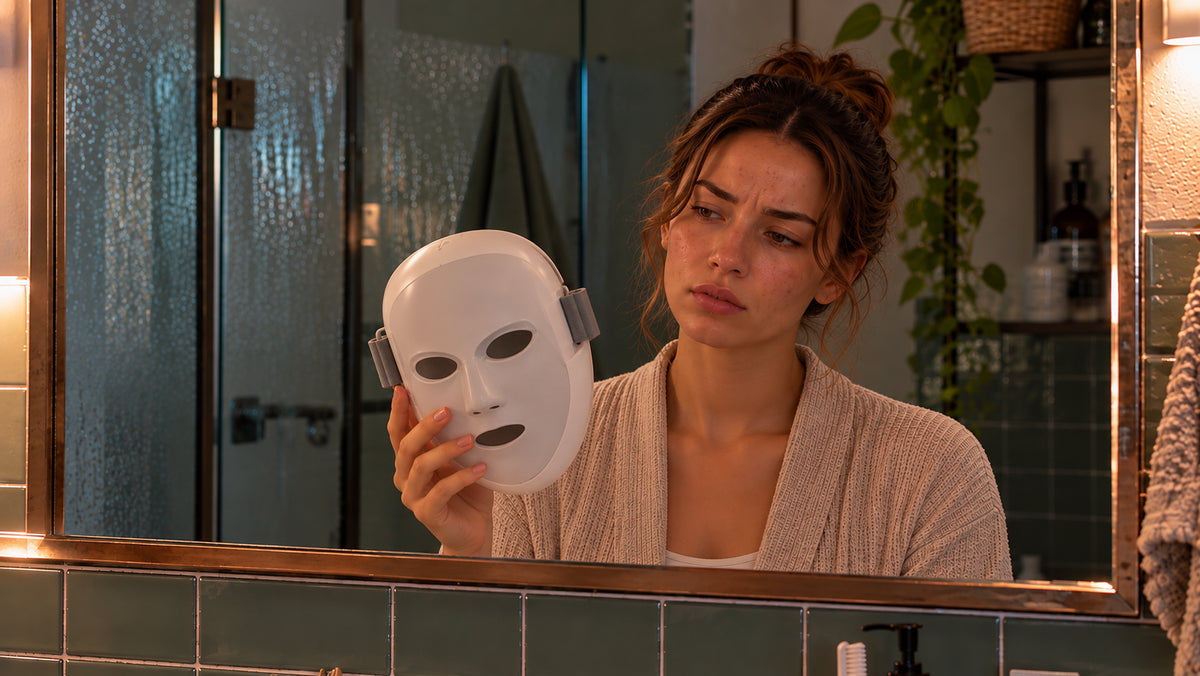
An LED mask that produces nothing after two months is usually being used wrongly rather than broken. Light therapy depends on delivering a specific wavelength at a specific intensity for a specific length of time, and each of those three variables can be undermined without anything looking obviously out of place.
The errors below are the ones that cost people results, ordered by when they tend to happen, starting with the purchase itself and ending with how the outcome gets judged. Several are invisible from the outside, which is exactly why a mask can feel like it is working while delivering a fraction of what it should.
Why Your LED Mask Is Not Showing Results
Delivered dose is the thing almost every mistake reduces. Irradiance multiplied by session length gives the energy the skin actually receives, and the wavelength determines what that energy reaches, so anything that interferes with those three leaves the session technically completed and functionally short.
| Mistake | What it costs you | The fix |
|---|---|---|
| No published wavelength or irradiance figures | Unknown dose, no way to judge the device | Buy only on stated nanometers and mW/cm² |
| Running the wrong color for the concern | Light that never reaches the right depth | Match the wavelength to the layer involved |
| Applying serums before a session | Product sitting between the light and the skin | Clean, dry skin, with skincare afterward |
| Mask sitting off the face | Lower intensity than the specification states | Close, even contact across the whole face |
| Sessions cut short or stretched long | Under-dosing, or exposure past the optimum | Follow the stated session length |
| Treating daily without rest | Less benefit rather than more | The frequency in your device’s instructions |
| Judging at four weeks | Abandoning a protocol before it reports | Twelve weeks before any verdict |
Each of these is worth understanding rather than just correcting, because the reasoning determines what to do when a situation falls outside the guidance.
Buying an LED Mask Without Published Specs
Marketing language is not specification. "Clinical-grade red light" and "medical LEDs" describe nothing measurable, and a device whose nanometer figures and irradiance are absent from the product page cannot be assessed against the research at all, since every trial in photobiomodulation reports exactly those numbers.
Two figures matter before anything else. The wavelength, in nanometers, decides which tissue absorbs the light, and a range as broad as "red and infrared" leaves open whether the device sits near the researched 633 to 660nm band or well outside it. Irradiance, in mW/cm², sets how much energy arrives per second, which combines with session length to produce the delivered dose, and without it the recommended 10 or 15 minutes is an arbitrary number.
Diode count is the figure brands publish instead, and it is the least informative of the three. A high count tells you nothing about output per diode, the spread across the face, or the wavelengths involved, and masks with fewer, better-specified LEDs frequently deliver more usable light than denser arrays with no figures attached.

Using the Wrong LED Light Color
Wavelength determines depth, which means the color decides whether the light ever reaches the structures behind a given concern. Blue sits in the epidermis and the follicle, green reaches the basal layer where melanocytes sit, yellow is absorbed in the superficial vasculature, red works through the dermis, and near-infrared carries below it. A concern rooted in the dermis cannot be addressed by light that stops at the surface, however many sessions are run.
The common version of this error is running one favored mode for everything. Red light on active breakouts does little about the bacterial component that blue addresses, and blue light on fine lines never reaches the fibroblasts involved. Neither feels like a mistake during the session, since both are comfortable and both finish on schedule.
Default-to-blue deserves separate mention, because it is the one color with a reason to be restrained rather than maximized. Blue light has a more specific role in acne treatment, so there is little reason to use it across areas that do not have congestion as the target.
Using an LED Mask Over Skincare
Serums, moisturizers, and sunscreen sit physically between the LEDs and the skin, and anything occlusive, pigmented, or reflective changes how much light arrives. Most products have never been tested under LED exposure, so the amount absorbed, scattered, or reflected is simply unknown, which turns a measured dose into a guess.
Clean, dry skin is the condition every clinical protocol uses, and it is the only one with evidence behind it. Cleansing before a session and applying everything afterward costs nothing and removes the variable entirely.
Active ingredients add a second issue. Acids, retinoids, and vitamin C left on the skin during a session are being exposed to light and warmth without any data on how they behave, and retinoids in particular are better kept to the other end of the routine. Applying them after the session, once the skin has settled, keeps both parts of the routine doing their own job.

Wearing an LED Mask Too Far From the Skin
Irradiance figures are measured at a stated distance, usually with the device against or very near the skin, and the intensity reaching the surface drops as that gap widens. A mask bridging over the cheekbones or standing off the forehead is delivering less to those areas than the specification implies, and the shortfall is largest exactly where the fit is worst.
Fit varies more than people expect across face shapes, since any mask is built around an average that no individual face matches precisely. Rigid designs can bridge across the nose or the brow on some faces while sitting flush on others, and flexible ones can tent over the same areas when the straps are loose. Checking where the mask actually touches, in a mirror, before a session reveals this in a few seconds.
Straps and position fix most of it. Tightening until the contact is even rather than merely secure, keeping the head still rather than reclining mid-session, and resisting the urge to talk or look around all help keep the distance consistent for the full duration.
Wearing an LED Mask for Too Long
Longer is not stronger. Photobiomodulation follows a biphasic dose response, where benefit rises with dose to a peak and then falls away, so exposure past the optimum produces less effect than the correct amount rather than an incremental gain, and the stated session length is set against the device's own irradiance to land near that peak.
Doubling a session therefore does not double anything. A mask rated for 10 minutes at a given output has been specified that way because 20 minutes pushes past the point where the response improves, which is also why timings borrowed from a different mask are unreliable, since a brighter device reaches the same dose sooner.
Cutting sessions short is the same error in reverse and more common in practice. Removing a mask at six minutes of a prescribed fifteen delivers under half the intended energy, and a routine built on consistently short sessions can run for months while never reaching the dose the research describes.
Can You Overuse an LED Mask?
Daily use is the most frequent overcorrection, and it comes from treating light therapy like a skincare step rather than a dose. Cells need recovery time between exposures, which is why most manufacturers specify a number of sessions per week rather than a daily routine, and why the burst of daily use that follows a new purchase rarely produces faster change than the schedule on the box.
Recommended frequency varies by device, since it depends on the irradiance and session length the manufacturer has set, and a figure borrowed from another mask or from general advice online may be well above or below what yours is built for. The instructions that came with the device are the reference point, and anything beyond them is worth raising with a dermatologist rather than self-prescribing.
Overuse rarely shows up as damage. The usual outcome is a plateau, where results stall rather than reverse, and the natural response is to add more sessions, which deepens the problem. Dryness, mild sensitivity, or a warm, tight feeling afterward are the signals worth noticing, and the right adjustment is fewer sessions rather than a different device.
One exception applies to targeted work. Blue light on an active breakout benefits from consistency across the eight to twelve weeks the trials measure, then drops back once the lesions settle, rather than continuing at the same rate indefinitely.
How Long Before an LED Mask Works?
Twelve weeks is the honest answer for most concerns, and judging earlier is the mistake that ends more routines than any technical error. Collagen synthesis runs on a timescale of months, so a device producing nothing visible at week four is behaving normally rather than failing. The published work reflects that timeline, with controlled studies on red light for photoaging measuring their outcomes across twelve weeks of regular sessions rather than a handful.
Repeat exposure is the variable that matters, not intensity in any single session, and the AAD guidance on light treatment makes the same point in saying that most people need a series of treatments rather than one.
Different concerns report at different times, which makes a single expectation unhelpful. Texture and comfort shift first, usually inside the first month. Inflammatory breakouts reduce across eight to twelve weeks, the window the blue light trials are built around. Pigmentation and post-breakout marks take three to six months, and firmness beyond six.
Photographs under consistent conditions are worth more than memory, since gradual change is almost impossible to perceive day to day, and a mirror at week eight offers no reliable comparison with a face last assessed at week one.

LED Mask With Published Specs
Avoiding most of the mistakes above comes down to a device that publishes what it delivers and lets the light be put where it belongs. The Artemis LED Mask states both numbers that matter, at 720 LEDs producing 45mW/cm², and names each wavelength individually rather than describing modes by color.
- Seven stated wavelengths – red at 635nm, near-infrared at 850nm, blue at 470nm, green at 525nm, amber at 590nm, sky blue at 520nm and violet, each published as a figure that can be checked against the research.
- 16 selectable zones – wavelengths assigned area by area through the app, which keeps blue where congestion is rather than across skin that has none.
- Saved protocols – zone settings held between sessions, so a routine worked out once runs the same way afterward.
- Built-in eye guards – protection fitted to the mask rather than supplied as a separate accessory to misplace.
Published figures also make the session length meaningful, since a stated irradiance is what allows a recommended duration to be checked rather than taken on trust. An optional neck plate covers the area below the jawline, and the full Artemis range lists it alongside the rest of the line.
Verdict: Avoiding LED Mask Mistakes
Nearly every mistake on this list reduces delivered dose. Product between the light and the skin, a gap where there should be contact, a session cut short or stretched past its optimum, and a wavelength that never reaches the right depth all end with less usable light than the device is capable of, and none of them announce themselves while they are happening.
The corrections are unglamorous and cheap. Buy on published nanometer and irradiance figures, match the color to the concern, treat clean, dry skin, check where the mask actually touches, and follow the stated duration and frequency rather than a schedule borrowed from elsewhere.
Patience is the last of them and the hardest. Twelve weeks of consistent use is the minimum before a device has told you anything, and the most common reason an LED mask appears not to work is a verdict reached at week four.
Related Articles
#All #All
Common LED Mask Mistakes
Read More #All
LED Light Therapy for Combination Skin
Read More #All
Red Light Therapy Before and After: What Changes and When
Read More #All
LED Light Therapy for Under-Eye Bags
Read More #All
Red Light vs Blue Light Therapy
Read More #All
LED Face Mask Guide: Benefits and Routine Tips
Read More #All
Starting LED Light Therapy in Your 20s
Read More #All
LED Light Therapy vs Microcurrent
Read More #All
LED Light Therapy for Oily Skin
Read More #All
Best Treatment for Sun-Damaged Skin
Read More #All
How to Repair a Damaged Skin Barrier
Read More #All
How to Fade Post-Acne Marks
Read More #All
Red Light Therapy for Skin Texture
Read More #All
Morning vs Night: When to Use an LED Mask
Read More #All
LED Light Therapy for Neck and Décolleté
Read More #All
LED Mask for Aging Skin
Read More#All
The 8 Best Luxury LED Face Masks in 2026
Read More
/


