

 #All
#AllRed Light Therapy for Skin Texture
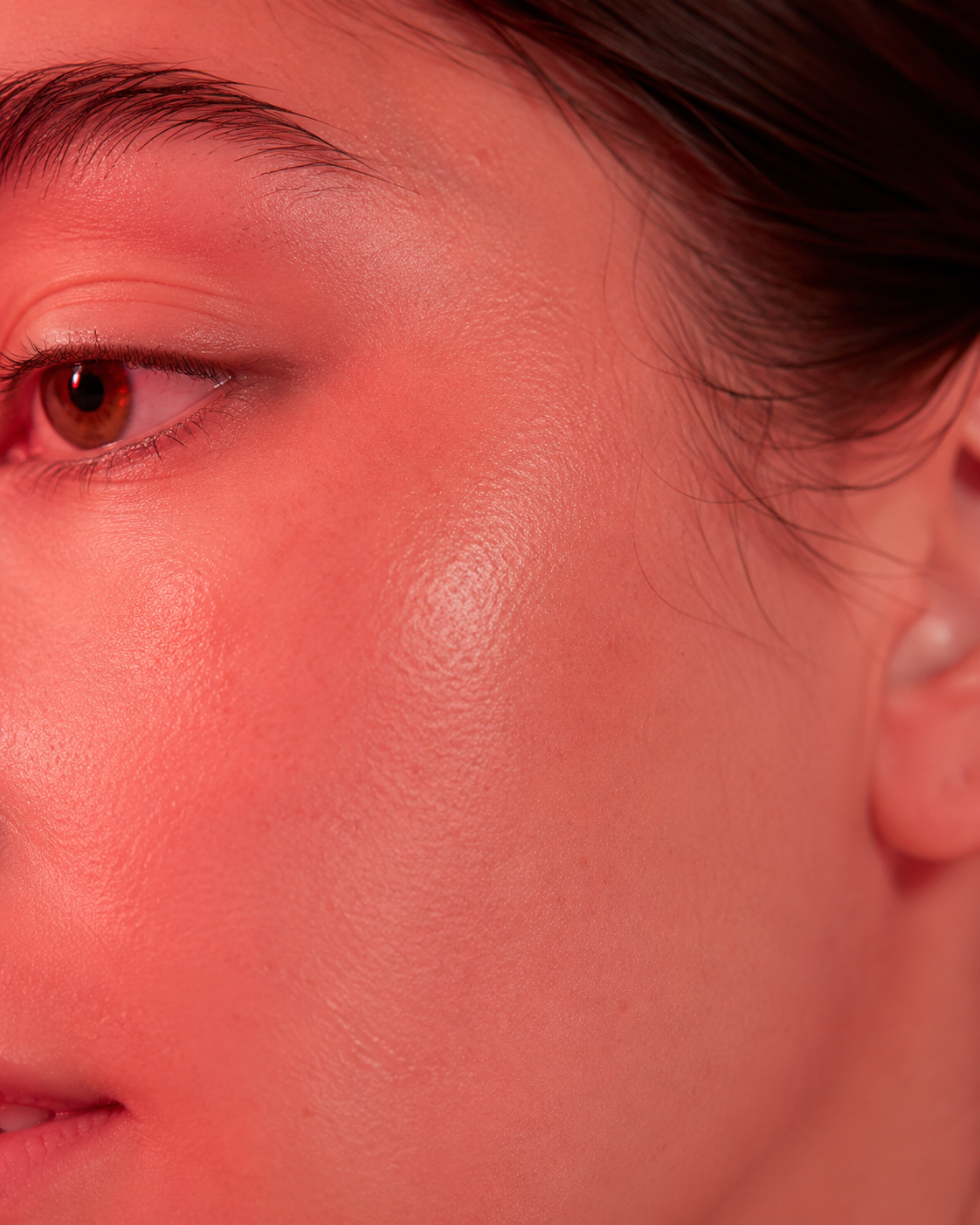
Skin texture is what people notice before they notice lines. Roughness, visible pores, and an uneven surface change how skin catches light long before any wrinkle becomes obvious, which is why texture is often the first concern that sends someone looking for a treatment.
Red light therapy addresses texture through the same mechanism it addresses aging: by supporting the cells that produce collagen. That makes it slower than an exfoliating acid and more sustainable than one, since nothing is being stripped away and nothing needs recovering from.
What Causes Uneven Skin Texture?
Texture is the sum of several processes rather than a single problem, and most skin showing it has more than one of the following at work.
Slowed Cell Turnover
Renewal slows with age, so dead cells linger at the surface longer than they once did and skin loses the smoothness it had when shedding happened faster. This is the most common contributor and the one most responsive to routine changes.
Collagen Loss
Production declines steadily from the mid-twenties onward, and skin with less structural support beneath it sits less evenly. This is the cause red light therapy acts on directly, and the reason texture and firmness tend to change together.
Sun Damage
Ultraviolet exposure breaks down existing collagen and interferes with the fibroblasts that produce more, which is why photoaged skin shows roughness and irregularity considerably earlier than protected skin does.
Congestion
Skin producing excess oil or shedding cells unevenly develops the small bumps and blocked follicles that read as rough to the touch, and repeated breakouts leave surface changes that persist after the breakout itself clears.
Dehydration
The most reversible cause and the most often mistaken for something permanent. Skin low on water reflects light unevenly and feels rough regardless of what is happening structurally underneath.

Why Pores Look Larger Over Time
Pore size is largely fixed by genetics and sebum production, and nothing in a bottle or a device changes the physical opening. What changes is the skin around it, which is why pores that were barely noticeable at twenty become a visible concern decades later without having grown at all. Collagen and elastin hold the structure surrounding each follicle. As both decline, that structure loses tension, and the opening loses definition, so a pore that measured the same twenty years earlier now reads as larger because the skin holding its shape has less to hold it with.
Oil and debris compound the appearance. A follicle filled with sebum and dead cells sits more visibly than an empty one, which is why pores look smaller immediately after a thorough cleanse and gradually more obvious through the day.
Sun damage is the third factor, and it works through the same route as everything else. Degraded collagen means less support, less support means less definition, and the cumulative effect over decades is more visible on skin that has had more exposure.
Does Red Light Therapy Help With Skin Texture?
Red light acts on the structural cause rather than the surface, which is what separates it from exfoliation. Wavelengths around 630 to 660nm reach the dermis, where they are absorbed by mitochondria and support the cellular energy production that fibroblasts use to synthesize collagen and elastin.
Clinical evidence for the effect is reasonably strong. A randomised split-face trial using 633nm and 830nm LEDs recorded significant improvements in skin elasticity alongside histological findings of a marked increase in collagen and elastic fibers, with highly activated fibroblasts in the treated tissue.
Texture responds earlier than lines do in most people's experience. Smoothness and the way skin reflects light depend on the upper dermis and the surface above it, which begins changing before any measurable difference appears in a wrinkle, and this is why texture improvements are frequently the first thing noticed.
What red light does not do is remove anything. There is no exfoliation, no peeling, and no shedding of the surface, so the improvement comes from the skin beneath being better supported rather than from a layer being taken off.
Can Red Light Therapy Make Pores Look Smaller?
It can change how pores appear, and the distinction matters. Nothing shrinks a pore, and any product or device claiming to is describing an effect it cannot produce, which is worth knowing before comparing claims across the category. What red light influences is the structure around the opening. Supporting collagen and elastin production means the skin surrounding each follicle holds its tension better, and better tension means more definition, which is what makes a pore read as smaller even though its physical dimensions are unchanged.
The effect is gradual and modest rather than dramatic. Anyone expecting the immediate tightening that a clay mask or an astringent produces will find light therapy underwhelming by comparison, though the difference is that those effects last hours while this one accumulates.
Congestion is the other half of the picture, and red light does not address it. Skin where pores appear enlarged because they are blocked benefits from blue light acting on the bacteria involved in congestion, which is a separate mechanism running alongside rather than instead.
Which Wavelengths Work Best for Texture
Texture rarely has a single cause, and the wavelengths that address it work on different parts of the problem.
| Wavelength | What it addresses | When it applies |
|---|---|---|
| Red, around 635nm | Collagen and elastin production in the dermis | The foundation of any texture routine |
| Near-infrared, around 850nm | The same processes at greater depth | Paired with red rather than used alone |
| Blue, around 470nm | Bacteria involved in congestion | Where blocked follicles contribute to roughness |
| Green, around 525nm | Pigmentation and evenness of tone | Where unevenness is color rather than surface |
Red and near-infrared do the structural work, and they are almost always used together because the combination reaches more of the tissue involved than either does alone.
Blue earns its place where congestion contributes rather than collagen loss, and applying it to the areas where congestion actually sits is more useful than treating the whole face with it. Green addresses tone rather than texture, though the two are frequently confused, since skin reading as uneven because of pigmentation is a different problem from skin that is physically irregular.

How Long Before Texture Improves
Texture generally responds before lines do, though both run on a timescale measured in weeks rather than days, since collagen synthesis is a slow biological process and no device accelerates it. Early changes tend to be tactile rather than visible. Skin feeling smoother, less rough to the touch and better hydrated is commonly reported within the first few weeks of consistent sessions, ahead of any change obvious in a mirror.
Visible improvement in surface evenness and pore definition follows later, typically after several weeks to a few months of regular use, and continues developing as collagen synthesis accumulates. This is a slower process than exfoliation and a more durable one, since nothing is being removed that then needs to regenerate.
Consistency determines the outcome more than session length does, and research on photobiomodulation has found that the response reaches a maximum at a certain dose before diminishing, so running longer sessions than a device recommends is not a route to faster results.
What Skincare Works Best With Light Therapy for Texture
Light therapy handles the structural side of texture while topical products handle the surface, which makes them complementary rather than competing for the same job. Retinoids are the most useful pairing for texture specifically, since they accelerate cell turnover while light therapy supports the collagen underneath. Both should be applied after a session rather than before, since anything sitting on the skin interferes with light reaching it, and skin already using a retinoid should introduce light therapy gradually rather than starting both at once.
Exfoliating acids work on the same surface layer and need more separation. Using AHAs or BHAs on different evenings from light therapy sessions is more comfortable than stacking them, particularly for anyone whose skin reacts easily.
Niacinamide suits pore appearance specifically and pairs well with any wavelength, since it supports barrier function rather than acting as an exfoliant. Hyaluronic acid and ceramides are worth applying immediately after a session, when hydration does the most for how smooth skin looks and feels.
Sunscreen matters more than any of it. Ultraviolet exposure degrades the collagen that light therapy supports, and a routine built around texture is undermined by skipping the one product that prevents further damage.

Choosing a Mask for Texture and Tone
Wavelength range determines how much of the problem a single device can address. Texture is rarely caused by one thing, so a mask covering red and near-infrared for structure, blue for congestion, and green for tone handles skin presenting several contributors rather than requiring separate treatments.
Coverage matters for texture more than for most concerns, since roughness and enlarged pores concentrate in specific areas rather than distributing evenly. Masks treating the whole face with one wavelength at a time apply the same treatment to a congested T-zone and a dry cheek, which suits neither.
The Artemis LED Mask is built around that distinction. Its app assigns any of its wavelengths to 16 separate facial zones, so blue can run where congestion contributes to texture while red and near-infrared run across the areas where collagen support is what matters, in a single session rather than two.
It carries 720 LEDs across the face at 45mW/cm², running red at 635nm, near-infrared at 850nm and blue at 470nm alongside green, yellow and sky blue, with built-in eye guards and a one-year warranty. The full Artemis range adds a neck plate for anyone extending the same treatment below the jawline.
Takeaway: What Red Light Therapy Does for Skin Texture
Red light works on the cause of uneven texture rather than on the surface, supporting the collagen and elastin that hold skin evenly and give pores their definition. That makes it slower than exfoliation and more durable, since the improvement comes from better support underneath rather than from a layer being removed.
Pores are the one expectation worth setting carefully. Nothing changes the physical size of a follicle, and what light therapy influences is the tension of the skin around it, which changes how a pore appears without changing what it measures.
The realistic picture is gradual. Skin usually feels smoother before it looks different, visible changes in evenness follow over months, and the routines producing results are the ones that fit comfortably into an ordinary week rather than the ones demanding rearranging it.
Related Articles
#All #All
#AllLED Light Therapy for Under-Eye Bags
Read More #All
#AllRed Light vs Blue Light Therapy
Read More #All
#AllLED Face Mask Guide: Benefits and Routine Tips
Read More #All
#AllLED Light Therapy vs Microcurrent
Read More #All
#AllLED Light Therapy for Oily Skin
Read More #All
#AllBest Treatment for Sun-Damaged Skin
Read More #All
#AllHow to Repair a Damaged Skin Barrier
Read More #All
#AllHow to Fade Post-Acne Marks
Read More #All
#AllRed Light Therapy for Skin Texture
Read More #All
#AllMorning vs Night: When to Use an LED Mask
Read More #All
#AllLED Light Therapy for Neck and Décolleté
Read More #All
#AllLED Mask for Aging Skin
Read More#All
The 10 Best LED Masks Recommended by Dermatologists in 2026
Read More#All
The 10 Best LED Light Therapy Face Masks in 2026
Read More
/


