

 #All
#AllLED Light Therapy vs Microcurrent
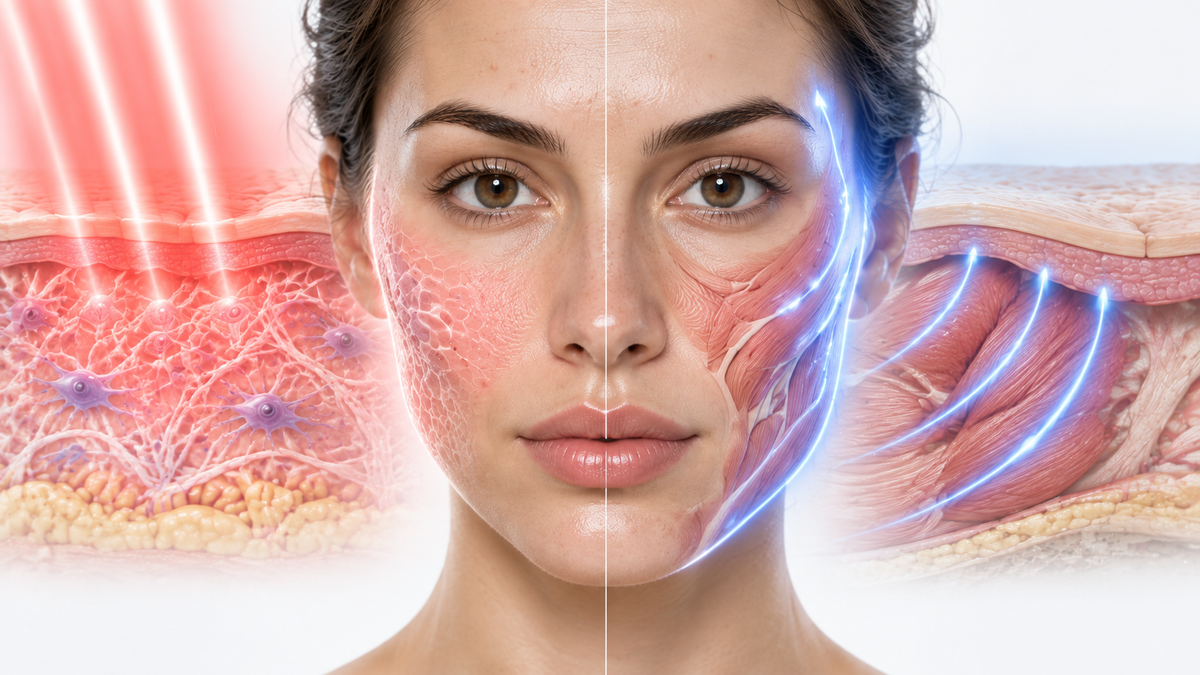
LED light therapy and microcurrent are frequently compared as though a buyer has to choose between them, and the comparison is misleading because they act on entirely different structures. One works on skin cells and the other works on the muscles beneath them.
That difference explains almost everything else, including why microcurrent produces a visible change within hours, and LED takes months, and why the results from each behave so differently once the routine stops.
How LED Light Therapy Works on Skin

LED light therapy delivers specific wavelengths of visible and near-infrared light into the skin at intensities low enough to produce no heat. Red at around 635nm and near-infrared at around 850nm are absorbed by mitochondria in the dermis, where they support the cellular energy production that fibroblasts use to synthesize collagen and elastin.
The result is structural rather than immediate. A randomized trial using these wavelengths recorded significant reductions in wrinkle depth and improvements in elasticity, with histology showing increases in collagen and elastic fibers, and those changes accumulate across months rather than appearing after a session. Devices carrying additional wavelengths extend the same principle to congestion, pigmentation, and redness, which is why a single LED mask can address several concerns while a microcurrent device addresses one.
Microcurrent Explained

Microcurrent delivers a low-level electrical current through the skin to the facial muscles beneath it, using handheld probes moved along the muscle in a specific direction. The currents involved are measured in millionths of an ampere, low enough that most people feel nothing beyond a faint metallic taste.
The effect works on muscle tone rather than on skin quality. Stimulating the muscle produces a temporary contraction and re-education of resting tone, which is what creates the lifted appearance the treatment is known for, particularly along the jawline and around the brow. Some research also suggests effects on cellular activity in the skin itself, though the visible result is muscular and the comparison people make is to exercise rather than to skincare.
Where LED and Microcurrent Differ
The two are frequently sold as alternatives when almost nothing about them overlaps, and setting the mechanisms side by side makes the extent of that clear.
| LED Light Therapy | Microcurrent | |
|---|---|---|
| Acts on | Skin cells in the dermis | Facial muscles beneath the skin |
| Mechanism | Light absorbed by mitochondria | Low-level electrical current |
| Main effect | Collagen and elastin production | Muscle tone and lift |
| Onset | Weeks to months | Within hours |
| Session length | 10 to 30 minutes, hands-free | 5 to 20 minutes, hands-on |
| Effort | Passive, worn on the face | Active, requires technique |
| Addresses | Lines, texture, tone, congestion | Jawline definition, brow position, sagging |
The clearest way to hold the distinction is that LED changes what the skin is made of while microcurrent changes how the muscles underneath are holding it. Neither does the other's job, and no amount of one substitutes for the other.
Which Works Faster, LED or Microcurrent?
Microcurrent works considerably faster, and this is the honest answer rather than a concession. A single session produces a visible change in jawline definition and brow position within hours, which is why it is popular before events and why professional facials often include it.
LED produces nothing visible in that timeframe. Texture and comfort shift within the first month, fine lines and tone between one and three months, and firmness beyond six, since collagen synthesis is slow and no device accelerates it meaningfully.
Judged on speed alone, microcurrent wins outright, and judged on what the change actually is, the comparison reverses. Microcurrent moves muscles that were already there, while LED alters the composition of the skin itself, and those are different kinds of results rather than faster and slower versions of the same one.
Duration of LED and Microcurrent Results
Microcurrent results fade within one to three days after a session, which is the central limitation of the treatment and the reason it is usually sold as a course rather than a one-off. Maintaining the effect means using it several times a week indefinitely, and stopping returns the muscles to their previous resting tone within a fortnight.
LED results accumulate rather than fading between sessions, since each one adds slightly to collagen production and the total builds over months. They also decline gradually once the routine stops, though the decline runs across months rather than days, and a person who used a mask consistently for a year does not return to their starting point within a week of stopping.
That difference is worth weighing against the effort each requires. Microcurrent asks for active technique several times weekly to hold a result that would otherwise disappear, while LED asks for passive sessions that build something slower and more durable.
Using LED Light Therapy and Microcurrent Together
The two combine well precisely because they do different jobs, and nothing about either interferes with the other provided the sequence is right. A few practical points make the combination workable:
- LED first, microcurrent after. Light needs clean, dry, product-free skin, while microcurrent requires a conductive gel, so running LED first avoids having to cleanse twice.
- Or separate them entirely. LED in the evening and microcurrent in the morning suits anyone who finds the combined session too long.
- Do not layer conductive gel under an LED mask. Anything on the skin absorbs or scatters light before it penetrates.
- Keep frequencies independent. Follow each device's own guidance rather than assuming a shared schedule.
- Introduce one at a time. Starting both in the same week makes any reaction impossible to attribute.
For anyone running both, the practical division is that LED handles skin quality over the long term while microcurrent handles definition in the short term, and the routine benefits from treating them as separate habits rather than as one combined treatment.
Choosing Between LED and Microcurrent
Where only one device is realistic, the concern decides it rather than any general ranking, since each handles some things well and others not at all.
Fine Lines and Texture
LED addresses these directly, since both are collagen and cell turnover concerns. Microcurrent does very little for them, because tightening a muscle does not change the condition of the skin above it.
Jawline Definition and Sagging
Microcurrent is the better fit, particularly where the concern is muscle tone rather than skin laxity. LED supports the skin holding that tissue and works considerably more slowly on it.
Breakouts and Congestion
LED with blue light specifically, since blue acts on the bacteria involved in congestion at the depth where they sit. Microcurrent has no role here at all, and using it on actively inflamed skin is generally advised against.
Pigmentation and Uneven Tone
LED again, with red supporting overall skin quality and green working at the depth where melanin sits. Microcurrent does nothing for pigment, since muscle tone has no bearing on how evenly skin is colored.
An Immediate Lift Before an Event
Microcurrent, without qualification. Anyone whose priority is looking different by Saturday should buy the device that works within hours rather than the one that works across months, and no amount of LED use produces that kind of same-day change.
What to Look for in an LED Mask

Wavelength range is the first thing to check, since red alone covers less than red paired with near-infrared, and the two reach different depths. Devices adding blue, green, and yellow extend the same mask to congestion, pigmentation, and redness, which is the main practical advantage LED holds over a single-purpose device.
Published output is the second. A mask stating its irradiance in mW/cm² alongside its wavelengths can be assessed against the research, while one listing only colors offers nothing to verify.
The Artemis LED Mask publishes both, carrying 720 LEDs across the face at 45mW/cm², running red at 635nm, near-infrared at 850nm and blue at 470nm alongside green, yellow, and sky blue. Its app assigns any wavelength to 16 separate facial zones, which allows different areas to receive different treatment within one session.
Sessions run hands-free, which is the practical distinction from microcurrent in daily use, since a mask worn for fifteen minutes requires nothing beyond wearing it. The full Artemis range adds a neck plate and a sterilizer case.
LED and Microcurrent: Two Different Jobs
Microcurrent tones muscle and LED rebuilds skin, and treating them as competitors misrepresents both. Anyone wanting a jawline to look sharper by the weekend is describing a microcurrent outcome, and anyone wanting skin that looks better in a year is describing an LED one.
The results behave as differently as the mechanisms. Microcurrent produces a lift within hours that fades within days and requires indefinite maintenance, while LED produces nothing for weeks and then accumulates into something that declines slowly rather than disappearing.
For most people building a routine rather than preparing for an occasion, LED is the more useful first purchase, since it addresses several concerns at once and asks for nothing beyond wearing it. Microcurrent earns its place alongside rather than instead, and the two together cover more ground than either does alone.
Related Articles
#All #All
#AllLED Light Therapy for Under-Eye Bags
Read More #All
#AllRed Light vs Blue Light Therapy
Read More #All
#AllLED Face Mask Guide: Benefits and Routine Tips
Read More #All
#AllLED Light Therapy vs Microcurrent
Read More #All
#AllLED Light Therapy for Oily Skin
Read More #All
#AllBest Treatment for Sun-Damaged Skin
Read More #All
#AllHow to Repair a Damaged Skin Barrier
Read More #All
#AllHow to Fade Post-Acne Marks
Read More #All
#AllRed Light Therapy for Skin Texture
Read More #All
#AllMorning vs Night: When to Use an LED Mask
Read More #All
#AllLED Light Therapy for Neck and Décolleté
Read More #All
#AllLED Mask for Aging Skin
Read More#All
The 10 Best LED Masks Recommended by Dermatologists in 2026
Read More#All
The 10 Best LED Light Therapy Face Masks in 2026
Read More
/


