

 #All
#AllBest Treatment for Sun-Damaged Skin
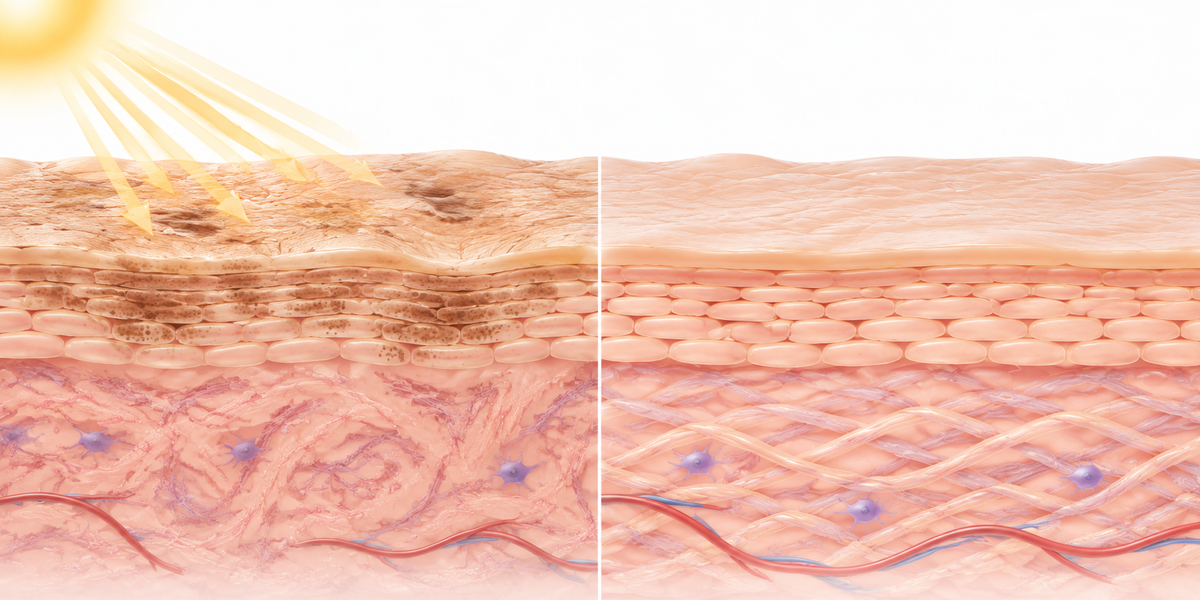
Sun damage accounts for most of what people call aging skin, and the estimate that repeatedly appears in dermatology is that ultraviolet exposure drives the large majority of visible facial aging. Lines, uneven tone, roughness, and loss of firmness all trace back to it more often than to the passage of time itself.
The useful distinction is between what can be improved and what can only be stopped from worsening. Some sun damage genuinely responds to treatment, some responds partially, and the single most effective intervention available is preventing the next twenty years of it rather than addressing the last twenty.
The answer depends on what type of damage you are trying to improve. Pigmentation, texture, fine lines, and firmness respond differently because they occur at different depths of the skin.
What Sun Damage Does to Skin
Ultraviolet light damages skin through two mechanisms working at different depths. UVB reaches the epidermis, where it damages cellular DNA directly and triggers the melanin production that shows up as tanning and, over time, as uneven pigmentation. UVA penetrates considerably further into the dermis, where it breaks down existing collagen and elastin while interfering with the fibroblasts that produce replacements.
That second process is what makes sun damage cumulative rather than temporary. Every exposure degrades a little more of the structural protein holding skin firm and smooth, and because the damage outpaces repair from early adulthood onward, the visible result compounds across decades. Photoaged skin and chronologically aged skin differ enough that dermatologists distinguish between them, and the difference is almost entirely UVA.
Signs of Sun-Damaged Skin
Photoaging presents differently from chronological aging, and the markers are recognizable once the two are separated, since skin that has simply aged looks thinner and finer while photodamaged skin looks rougher and more uneven:
- Uneven pigmentation, including sun spots, age spots, and patchy tone
- Fine lines in sun-exposed areas rather than distributed evenly across the face
- Rough, leathery texture, particularly across the cheeks and forehead
- Visible capillaries, most often around the nose and cheeks
- Loss of firmness that appears earlier than it would otherwise
- Sallow or yellowed tone, caused by degraded elastin accumulating in the dermis
- Deeper lines on one side in anyone who drives frequently, since one side takes more exposure
The asymmetry test is the clearest indicator. Comparing a sun-exposed area with skin that has been covered for decades, such as the inner upper arm, shows the difference between damaged and protected skin on the same person.
Can Sun Damage Be Reversed?

Partially, and the honest answer depends on which layer the damage sits in. Pigmentation responds well because melanin is produced continuously and the excess can be broken down and cleared as skin renews itself. Texture responds reasonably well for the same reason, since surface irregularity improves as turnover accelerates.
Structural damage is the harder case. Collagen and elastin broken down over decades can be partly rebuilt through treatments that stimulate production, though the fibers themselves are not restored to their original state, and deeply set changes such as leathery texture or severe elastosis improve rather than resolve. What no treatment does is undo the cellular DNA damage that has already occurred, which is why sun protection remains the only intervention that addresses the cause rather than the appearance.
Treatments for Sun-Damaged Skin
Several approaches work on sun damage, and the useful way to compare them is by which type of damage each addresses rather than by which is strongest, since they suit different problems rather than competing for the same one.
Retinoids
The most evidence-backed topical for photoaging, and the only ingredient class with decades of clinical data behind it for this specific purpose. Retinoids accelerate cell turnover while stimulating collagen production, which addresses pigmentation and texture simultaneously. They take three to six months to show results and require a gradual introduction, since the adjustment period involves dryness and sensitivity that leads many people to abandon them early.
Vitamin C
An antioxidant that interrupts melanin production and offers some protection against further free radical damage. It works best alongside sunscreen rather than instead of it, and it suits morning use, which makes it straightforward to combine with an evening retinoid.
Chemical Exfoliants
AHAs including glycolic and lactic acid accelerate the shedding of pigmented surface cells, which improves tone and texture faster than anything else applied topically. The trade-off is that overuse damages the skin barrier, and compromised skin tolerates neither sun nor treatment well.
In-Clinic Procedures
Chemical peels, laser resurfacing, IPL, and microneedling all produce faster and more dramatic results than home treatment, at correspondingly higher cost and with downtime. Anyone with a deeper skin tone should have their skin assessed before laser or peel treatment, since some procedures carry a risk of worsening pigmentation rather than clearing it.
LED Light Therapy
For anyone wanting a non-invasive option that addresses the structural side of photoaging, LED fills the gap between topical routines and in-clinic procedures. Topicals work mainly at the surface and clinic treatments work deeper at the cost of recovery time and expense, while light therapy reaches the dermis without disrupting anything, which makes it the option that runs alongside the rest rather than replacing them.
What Works for Which Type of Sun Damage

Matching the treatment to the damage matters more than choosing the strongest option available, and the table below sets out where each approach earns its place.
| Type of damage | Responds best to | Realistic outcome |
|---|---|---|
| Sun spots and uneven tone | Retinoids, vitamin C, acids, IPL | Substantial improvement over months |
| Rough or uneven texture | Retinoids, acids, light therapy | Good improvement, often noticed first |
| Fine lines from UVA | Retinoids, light therapy, resurfacing | Gradual softening rather than removal |
| Loss of firmness | Light therapy, microneedling, resurfacing | Modest improvement over six months plus |
| Leathery texture, deep elastosis | In-clinic resurfacing | Partial improvement at best |
| Visible capillaries | IPL or laser | Treatable, though not by topicals |
The pattern across the table is that surface damage responds better and faster than structural damage, which is the reverse of how most people prioritize their concerns. Anyone judging a routine by whether their firmness has improved will conclude it is not working, while the pigmentation and texture changes that arrived at eight weeks went unremarked.
How LED Light Therapy Helps Sun-Damaged Skin
Photoaging is fundamentally a collagen problem, since UVA spends decades degrading the structural protein that keeps skin firm and smooth, and that is the layer topicals struggle to reach. Red light at around 635nm and near-infrared at around 850nm are absorbed by mitochondria in the dermis, supporting the cellular energy production fibroblasts use to synthesize collagen and elastin, which is why light therapy addresses the part of sun damage that acids and retinoids largely cannot.
A randomized trial using these wavelengths recorded significant reductions in wrinkle depth and improvements in elasticity, with histology showing a marked increase in collagen and elastic fibers. What makes light therapy particularly suitable here is that photodamaged skin is often already compromised, and a treatment requiring no exfoliation and no recovery can run alongside topicals that do.
Green light at around 525nm addresses the pigmentation side, working at the depth where melanin sits, though the evidence behind it is considerably thinner than for red, and it is better understood as a supporting wavelength than as the primary answer.
How Long Sun Damage Takes to Improve
Pigmentation shows the earliest visible change, typically over eight to twelve weeks of consistent treatment, since excess melanin clears as surface cells shed and are replaced. Texture improves on a similar timeline and is frequently noticed before anything else, with skin feeling smoother well ahead of looking different.
Structural improvements take considerably longer. Firmness and fine lines build over three to six months and continue developing beyond that, since collagen synthesis is a slow process and no treatment accelerates it much. Deeper changes such as leathery texture improve over a year or more with sustained treatment, and they improve rather than resolve. The one certainty is that continued unprotected exposure undoes progress faster than any routine creates it.
Choosing a Mask for Photoaged Skin

Sun damage is the one concern where a single-wavelength device falls genuinely short, because photoaging presents on two fronts at once. Pigmentation sits at the surface where melanin accumulates, while the collagen breakdown that produces lines and slackening sits in the dermis beneath it, and no single wavelength reaches both.
Green light at around 525nm is the one associated with the pigmentation side, working at the depth where melanin is produced rather than penetrating past it. The evidence behind green is thinner than for red, which is why it belongs alongside the deeper wavelengths rather than instead of them, though a device carrying both means sun spots and firmness can be addressed in the same routine rather than requiring a separate approach for each.
The Artemis LED Mask runs green at 525nm alongside red at 635nm and near-infrared at 850nm, with blue, yellow, and sky blue completing the range, across 720 LEDs at 45mW/cm². Its app assigns any of those to 16 separate facial zones, which matters more for sun damage than for most concerns, given that exposure is rarely even, with one side of the face, the forehead, and the upper cheeks typically carrying considerably more than the rest.
The full Artemis range adds a neck plate, worth considering here because the chest and neck usually show sun damage earlier and more severely than the face while receiving a fraction of the attention.
Preventing Further Sun Damage
Every treatment above works against a process that continues daily unless it is stopped, which makes prevention the most effective intervention available rather than an afterthought to treatment. Broad-spectrum sunscreen at SPF 30 or higher, applied every morning regardless of weather and reapplied throughout the day, prevents more damage than any treatment reverses. UVA passes through clouds and window glass, which is why drivers show more damage on one side and why indoor workers are not exempt. Hats, sunglasses, and shade during peak hours all contribute, and avoiding deliberate tanning is the single largest decision anyone makes about their skin's future appearance.
The arithmetic is worth stating plainly. A year of consistent treatment can meaningfully improve pigmentation and texture, and a single summer without protection undoes a good deal of it, which is why sunscreen belongs inside a treatment routine rather than alongside one. Light therapy, retinoids, and everything else on this page work on damage that has already happened, while sunscreen is the only thing that reduces how much there is to treat, and the two together produce results that neither manages alone.
Related Articles
#All #All
#AllLED Light Therapy for Under-Eye Bags
Read More #All
#AllRed Light vs Blue Light Therapy
Read More #All
#AllLED Face Mask Guide: Benefits and Routine Tips
Read More #All
#AllLED Light Therapy vs Microcurrent
Read More #All
#AllLED Light Therapy for Oily Skin
Read More #All
#AllBest Treatment for Sun-Damaged Skin
Read More #All
#AllHow to Repair a Damaged Skin Barrier
Read More #All
#AllHow to Fade Post-Acne Marks
Read More #All
#AllRed Light Therapy for Skin Texture
Read More #All
#AllMorning vs Night: When to Use an LED Mask
Read More #All
#AllLED Light Therapy for Neck and Décolleté
Read More #All
#AllLED Mask for Aging Skin
Read More#All
The 10 Best LED Masks Recommended by Dermatologists in 2026
Read More#All
The 10 Best LED Light Therapy Face Masks in 2026
Read More
/


