

 #All
#AllHow to Fade Post-Acne Marks
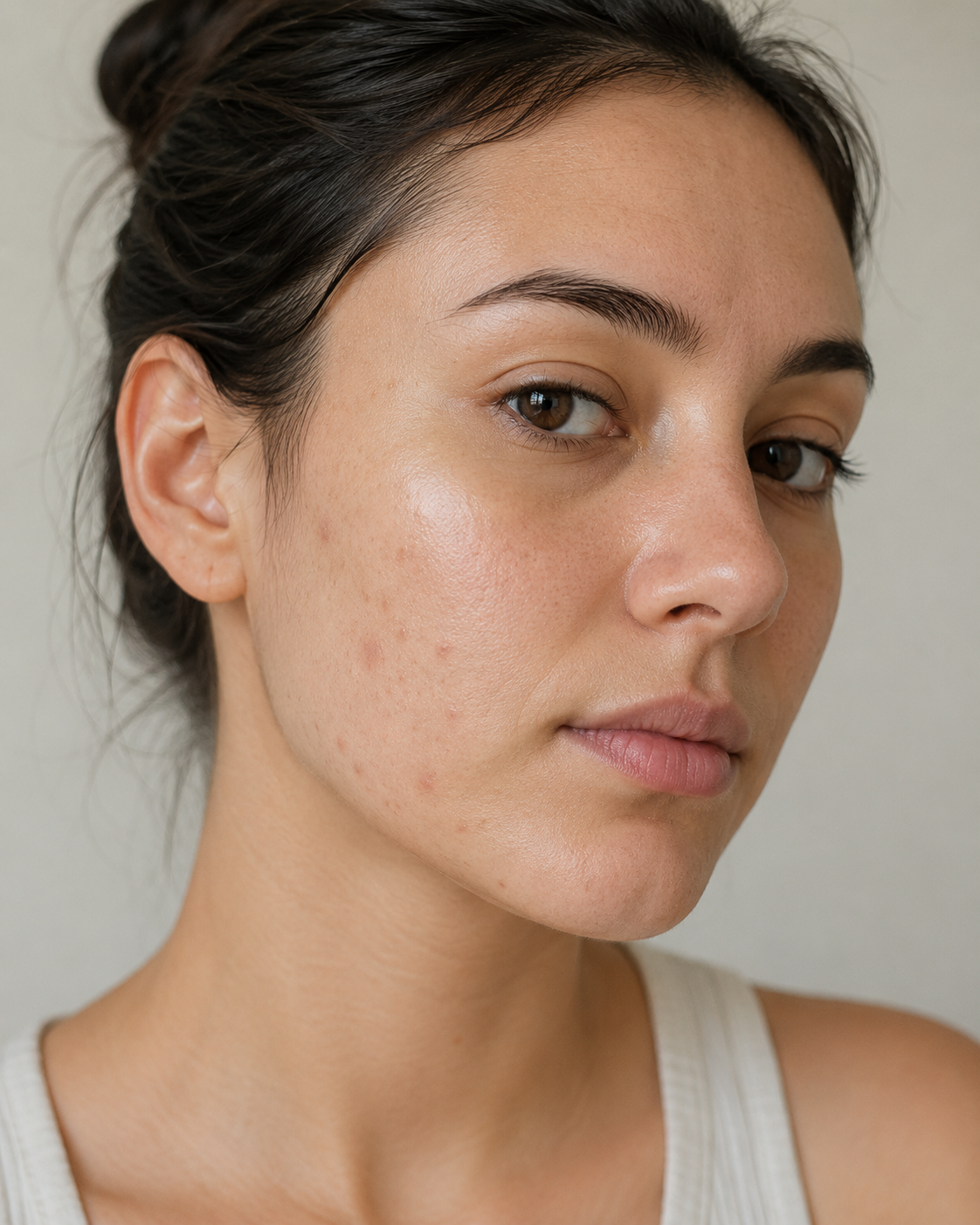
Post-acne marks are what remains after a breakout has healed, and they frequently last longer than the breakout that caused them. A spot resolves in days while the mark it leaves can sit for months, which is why clearing acne and clearing the evidence of acne are two separate projects.
Most marks fade on their own eventually. The useful question is what shortens that process, what lengthens it, and which of the two types of mark is actually present, since the brown ones and the red ones behave differently and respond to different things.
What Are Post-Acne Marks?
Post-acne marks are flat areas of discoloration left behind after inflammation subsides. The skin surface is intact and level, and what remains is a change in color rather than a change in texture, which is the distinction that determines whether anything can fade them. Scarring is the alternative outcome and a different problem entirely. Ice pick, boxcar, and rolling scars involve tissue loss or excess, so the surface is physically irregular, and no amount of pigment correction changes a depression in the skin.
The confusion between them is understandable, since both appear after acne and both persist. Running a finger over the area settles it, as a mark feels the same as the skin around it while a scar does not.
Time resolves most marks without intervention. What treatment offers is a shorter timeline and, in some cases, a better final result, rather than the difference between fading and not fading.
What Causes Post-Acne Marks?
Inflammation is the trigger for both types. When a breakout inflames the surrounding tissue, the skin responds in ways that outlast the inflammation itself, and the form that response takes determines which mark appears. Melanin overproduction causes the brown marks. Inflammation stimulates melanocytes to produce excess pigment, which is a protective response that persists after the cause has gone. This happens more readily in deeper skin tones, where melanocytes are more reactive, which is why post-acne pigmentation is both more common and more persistent in medium to deep complexions.
Dilated capillaries cause the red and purple ones. The vessels that widened to deliver blood to an inflamed area sometimes stay dilated after healing, leaving visible redness where the breakout was.
Picking makes both considerably worse. Extracting or squeezing a spot extends the inflammation deeper and over a wider area, which produces more pigment, more vessel involvement, and a mark that lasts substantially longer than one left alone.
Sun exposure compounds the pigmented version specifically, since ultraviolet light stimulates the same melanocytes that inflammation has already activated, deepening a mark that would otherwise be fading.

Types of Post-Acne Marks
Two distinct types account for almost all post-acne discoloration, and telling them apart matters because they respond to different things.
| Post-inflammatory hyperpigmentation | Post-inflammatory erythema | |
|---|---|---|
| Appearance | Brown, tan or grey | Pink, red or purple |
| Cause | Excess melanin production | Dilated blood vessels |
| Under finger pressure | Stays the same color | Briefly blanches |
| More common in | Medium to deep skin tones | Lighter skin tones |
| Typical timeline | Six months to a year, sometimes longer | Three to six months |
| Wavelength that applies | Green, at the depth where melanin sits | Yellow, at the depth where vessels sit |
Where pigment sits determines how quickly hyperpigmentation clears, since melanin in the upper layers lifts as skin renews itself while pigment that has dropped deeper into the dermis persists considerably longer.
Erythema behaves differently, often looking worse after heat, exercise, or alcohol, since anything that dilates vessels makes it more visible. Both types can appear on the same face, and a single mark can involve both, which is why some areas respond to a treatment that does nothing for others.
How Long Post-Acne Marks Take to Fade
Erythema generally clears faster than pigmentation. Red marks from dilated vessels typically fade over three to six months, while pigmented marks commonly take six months to a year, and deeper pigment can persist beyond that. Several factors extend those timelines. Continued sun exposure without protection is the most significant, since it actively deepens pigmentation while the skin is trying to clear it. Picking at healing spots restarts the inflammation. Repeated breakouts in the same area layer new marks over old ones before either has resolved.
Skin tone influences the picture too. Deeper complexions produce more pigment in response to inflammation and clear it more slowly, so a mark that fades in four months on fair skin may take twice that on darker skin.
Treatment shortens the process rather than transforming it. Anything promising to clear marks in days is describing something other than what happens biologically, since the pigment has to be broken down and carried away or shed as skin renews, and neither process is instant.
How LED Light Therapy Works on Acne Marks
Light therapy acts on the skin's own repair processes rather than on the pigment directly, which is the important distinction when setting expectations. Red at around 635nm and near-infrared at around 850nm reach the dermis, where they are absorbed by mitochondria and support the cellular energy production fibroblasts use. A randomised split-face trial using these wavelengths recorded increased collagen and elastic fibers alongside highly activated fibroblasts, which is the mechanism behind improvements in overall skin quality. Better-functioning skin renews more efficiently, and more efficient renewal clears surface pigment faster.
Green at around 525nm works closer to the surface, at the depth where melanin sits, and is the wavelength most often associated with pigmentation specifically. Evidence for it is considerably thinner than for red, so it is better understood as a supporting wavelength than as the primary answer.
Yellow at around 590nm addresses the redness side, working at the depth where dilated vessels sit, which makes it the more relevant wavelength for erythema than for pigmentation.
Blue at around 470nm does nothing for existing marks, since it acts on the bacteria involved in breakouts rather than on pigment or vessels. Its role is preventing the new breakouts that would otherwise create more marks, which matters but is a different job.
Treating Marks by Type
Matching the approach to the mark is what separates a routine that works from one that produces uneven results across the same face.
Treating Pigmented Marks
These respond to anything that accelerates cell turnover or interrupts melanin production. Sunscreen comes first and is not optional, since ultraviolet exposure actively deepens these marks faster than most treatments fade them. Vitamin C, niacinamide, and azelaic acid all address melanin production, and retinoids accelerate the renewal that carries pigment to the surface. Green light supports the process alongside them.
Treating Red Marks
These respond to different things, since there is no pigment to break down. Azelaic acid and niacinamide help by reducing vascular reactivity, yellow light works at the depth where the vessels sit, and time does much of the work as the capillaries gradually constrict. Aggressive exfoliation tends to make erythema worse rather than better, since it prolongs the inflammation that caused it.
Preventing New Marks
Both types benefit from stopping new breakouts, which is where blue light and a consistent acne routine matter. Marks accumulate faster than they clear if breakouts continue, and no fading treatment outpaces a continuing supply of new inflammation.
Neither type benefits from picking, scrubbing, or stacking multiple strong actives at once, all of which extend inflammation and lengthen the timeline.

When to See a Dermatologist
Certain presentations warrant professional assessment rather than a longer wait or another product. Marks persisting well beyond a year without visible improvement suggest either deeper pigment deposition or something other than post-inflammatory change, and both are worth having looked at properly.
Textural irregularity is the clearest indication. Anything that can be felt as a depression, a raised area or an uneven surface is scarring rather than marking, and it responds to procedures such as resurfacing, microneedling or subcision rather than to anything applied or shone at it.
Ongoing acne changes the priority. Treating marks while breakouts continue is working against a moving target, and prescription options for the acne itself will do more for the eventual appearance of the skin than any mark treatment applied on top.
Anyone considering stronger interventions such as chemical peels or laser treatment should have their skin tone assessed first, since some procedures carry a risk of worsening pigmentation in deeper complexions.

Choosing an LED Mask for Post-Acne Marks
Wavelength range matters more for marks than for most concerns, since the two mark types respond to different wavelengths and most faces carry both. A device offering red and near-infrared alone covers the skin quality argument and misses the rest. Adding green for pigmentation, yellow for redness, and blue for preventing new breakouts turns one device into something that addresses the whole picture rather than a third of it.
Targeting matters almost as much. Marks concentrate where breakouts happened rather than distributing evenly, so a mask treating the entire face with one wavelength applies the same treatment to marked areas and clear ones.
The Artemis LED Mask covers both requirements. It runs red at 635nm, near-infrared at 850nm, blue at 470nm, green at 525nm, yellow at 590nm, and sky blue, and its app assigns any of those to 16 separate facial zones, so green can run where pigmentation sits while yellow runs where redness does and blue treats the areas still breaking out.
It carries 720 LEDs across the face at 45mW/cm², with built-in eye guards and a one-year warranty. The full Artemis range adds a neck plate for anyone treating marks below the jawline.
Verdict: Does LED Light Therapy Fade Post-Acne Marks?
It supports the process rather than driving it. Red and near-infrared improve the skin quality that determines how efficiently pigment clears, green and yellow address the two mark types at the depths where each sits, and blue prevents the new breakouts that would otherwise keep adding to the total.
Sun protection, patience, and not picking account for most of the outcome. The first stops pigmented marks from deepening faster than anything can fade them, the second allows renewal to run its course, and the third avoids the extended inflammation that adds months to a timeline.
Set against that, light therapy is a reasonable accelerant rather than a solution on its own. The realistic expectation is a shorter timeline and better overall skin quality alongside it, achieved over months of consistent use rather than in the weeks that most marks would take to start fading anyway.
Related Articles
#All #All
#AllLED Light Therapy for Under-Eye Bags
Read More #All
#AllRed Light vs Blue Light Therapy
Read More #All
#AllLED Face Mask Guide: Benefits and Routine Tips
Read More #All
#AllLED Light Therapy vs Microcurrent
Read More #All
#AllLED Light Therapy for Oily Skin
Read More #All
#AllBest Treatment for Sun-Damaged Skin
Read More #All
#AllHow to Repair a Damaged Skin Barrier
Read More #All
#AllHow to Fade Post-Acne Marks
Read More #All
#AllRed Light Therapy for Skin Texture
Read More #All
#AllMorning vs Night: When to Use an LED Mask
Read More #All
#AllLED Light Therapy for Neck and Décolleté
Read More #All
#AllLED Mask for Aging Skin
Read More#All
The 10 Best LED Masks Recommended by Dermatologists in 2026
Read More#All
The 10 Best LED Light Therapy Face Masks in 2026
Read More
/


